French Language Course Online: Complete Beginner’s Guide
Starting to learn French can feel overwhelming. Between verb conjugations, gendered nouns, silent letters, and pronunciation rules that seem to break their own logic, it’s easy to understand why so many beginners give up before they ever hold a real conversation. But here’s the truth: French is entirely learnable, and with the right French language course online, you can go from knowing zero words to holding basic conversations faster than you think.
This guide is built specifically for absolute beginners — people just starting their French learning journey who want a clear, honest roadmap of what to expect, how to get started, and how to avoid the common pitfalls that derail so many learners in their first few months.
Why Start with an Online Course Instead of Teaching Yourself?
Many beginners try to learn French entirely on their own using apps, YouTube videos, or free worksheets. This can work for building basic vocabulary, but it often falls short in a few critical areas:
No corrective feedback: You can practice pronunciation for months without realizing you’re making the same mistake every time, because there’s no one to correct you in real time.
No structured progression: Random videos and app lessons often skip around topics without a clear sense of what should come first, second, and third.
Speaking anxiety builds up: The longer you go without speaking out loud to another person, the more intimidating it becomes to finally try.
Lack of accountability: Self-study is easy to abandon when life gets busy, since there’s no one checking in on your progress.
A structured French language course online solves all four of these problems by combining live instruction, a clear curriculum, and built-in accountability — while still giving you the flexibility to learn from home, on your own schedule.
What Absolute Beginners Should Expect in Their First Few Weeks
If you’re just starting out, here’s a realistic picture of what the first phase of learning French typically looks like in a well-structured course.
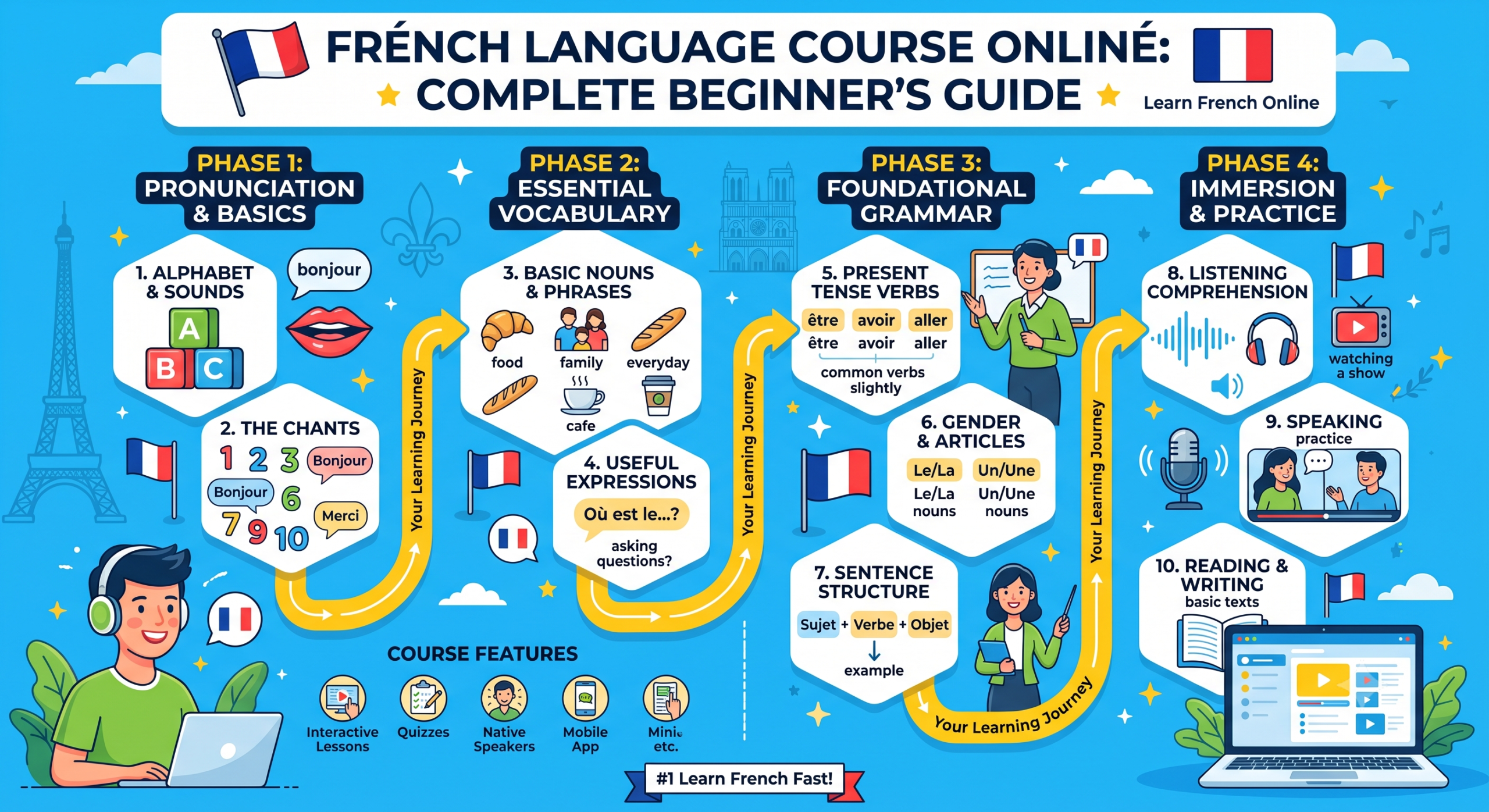
Week 1–2: The Basics of Pronunciation and Greetings
You’ll start with the French alphabet, basic pronunciation rules, and essential greetings like bonjour (hello), merci (thank you), and comment ça va (how are you). This stage also introduces gendered nouns (masculine le vs. feminine la), one of the first major differences from English that beginners need to get comfortable with early.
Week 3–4: Introducing Yourself and Simple Present Tense
You’ll learn how to say your name, where you’re from, your age, and your profession, while getting introduced to the present tense of common verbs like être (to be), avoir (to have), and regular -er verbs. This is usually where learners start to feel real progress, since they can finally construct original sentences.
Week 5–8: Everyday Vocabulary and Basic Conversations
This stage typically covers numbers, dates, time, family members, food, and shopping vocabulary, alongside basic question formation (Est-ce que…?, Qu’est-ce que…?). By the end, most beginners can handle short, practical exchanges — ordering food, asking for directions, or making small talk.
Month 3 and Beyond: Building Toward A1/A2 Level
By around the third month of consistent study (roughly 3–5 hours per week), most learners following a structured course reach the A1 level on the CEFR scale, and are well on their way to A2 — the stage where genuinely useful conversational ability begins to develop.
The Core Skills Every Beginner Course Should Cover
A well-rounded beginner’s French course should never focus on just one skill. Look for programs that build all four of these in parallel:
Listening comprehension — Understanding spoken French, even at a slow, simplified pace at first, trains your ear to recognize sounds, rhythm, and intonation patterns unique to French.
Speaking practice — Actually producing spoken French from day one, even in simple phrases, builds the muscle memory and confidence needed for real conversation.
Reading — Simple texts, dialogues, and eventually short articles reinforce vocabulary and grammar structures visually.
Writing — Basic writing exercises, from filling in blanks to short paragraphs, help solidify grammar rules and expand vocabulary retention.
Courses that only focus on grammar drills or vocabulary memorization — without regular speaking and listening practice — tend to produce learners who can pass a written test but freeze up in an actual conversation.
Common Beginner Struggles (And How to Overcome Them)
“French pronunciation feels impossible.”
French has sounds that don’t exist in English, like the nasal vowels in bon or vin, and the guttural French “r.” The key is not to rush this stage. Spend real time listening to native speakers and repeating after them, rather than memorizing spelling-to-sound rules in isolation. Many learners find that shadowing — listening to a short audio clip and repeating it immediately, mimicking rhythm and tone — dramatically speeds up pronunciation improvement.
“I don’t understand why every noun has a gender.”
This trips up almost every English-speaking beginner. The best approach isn’t to memorize gender rules in isolation, but to always learn nouns together with their article — le chat (the cat), not just chat. Over time, gender patterns start to feel more intuitive, especially as certain word endings (like -tion, which is almost always feminine) become familiar.
“I know vocabulary, but I freeze when I try to speak.”
This is one of the most common beginner frustrations, and it usually comes from a mismatch between passive knowledge (recognizing words) and active recall (producing them spontaneously). The fix is simple but requires discipline: speak out loud regularly, even alone, and prioritize courses with live speaking practice built in from the very first lesson.
“I keep forgetting vocabulary I already learned.”
This is normal and happens to everyone. Spaced repetition — reviewing vocabulary at increasing intervals over time — is one of the most scientifically supported methods to fight forgetting. Good online courses build this into their self-paced modules rather than expecting learners to review manually.
How to Choose the Right Beginner Course
When comparing options for a French language course online, beginners should specifically look for:
A true beginner track (A1 level) — not a general course that assumes prior knowledge.
Small class sizes or one-on-one options — beginners benefit enormously from individual attention and correction, which is harder to get in large group settings.
Native or certified instructors experienced with beginners — teaching absolute beginners requires a different skill set than teaching advanced students; patience and clear explanation matter more than anything else at this stage.
A clear, visible curriculum — you should be able to see exactly what topics are covered and in what order, so progress feels tangible.
Built-in speaking practice from lesson one — avoid courses that delay speaking until “you know more grammar.”
Flexible scheduling — beginners often benefit from more frequent, shorter sessions rather than infrequent long ones.
What Beginners Can Expect from Global Diction Studio
At Global Diction Studio, our beginner track is designed specifically around the challenges outlined above. New learners start with a dedicated A1-level curriculum that introduces pronunciation, essential grammar, and everyday vocabulary in a carefully sequenced order — never assuming prior knowledge.
Every beginner gets access to live classes with instructors experienced specifically in teaching absolute beginners, meaning explanations are clear, pacing is patient, and speaking practice starts immediately, not after weeks of passive grammar study. Between live sessions, self-paced modules reinforce vocabulary using spaced repetition, while pronunciation exercises use speech recognition technology to give immediate feedback — something self-study alone simply can’t replicate.
Learners can choose between small group classes, which offer peer practice and a collaborative learning environment, or one-on-one sessions for fully personalized pacing and attention. Progress is tracked transparently through a personal dashboard, so beginners always know exactly how far they’ve come and what’s coming next.
A Simple 3-Month Roadmap for Complete Beginners
If you’re just starting today, here’s a realistic goal-setting framework:
Month 1: Master pronunciation basics, greetings, numbers, and simple present-tense sentences. Goal: introduce yourself confidently.
Month 2: Build everyday vocabulary (food, family, shopping, time) and start asking and answering simple questions. Goal: handle a basic transactional conversation, like ordering at a café.
Month 3: Expand into past tense basics, more complex questions, and short dialogues. Goal: hold a 2–3 minute conversation about yourself, your day, or simple plans.
This pace assumes roughly 3–5 hours per week of combined live class time and self-practice — a realistic, sustainable commitment for most working adults or students.
Frequently Asked Questions
1. What is the best French language course online for absolute beginners?
The best course for beginners is one that offers a dedicated A1-level curriculum, live instructor-led classes, and speaking practice from lesson one — not just app-based vocabulary drills. Global Diction Studio’s beginner track is built specifically for learners starting from zero.
2. How long does it take to complete a French language course online?
Most learners reach basic conversational ability (A1–A2 level) within 3 to 6 months when studying 3–5 hours per week. Reaching intermediate fluency (B1–B2) typically takes 12 months or more of consistent practice.
3. Is a French language course online effective for complete beginners?
Yes. A well-structured online course with live classes, structured curriculum, and speaking practice is just as effective as in-person learning — often more so, thanks to personalized pacing and flexible scheduling.
4. Do I need any prior knowledge before joining a French language course online?
No. Beginner-level online courses are designed to start from zero, covering the alphabet, pronunciation, and basic grammar before moving into vocabulary and conversation.
5. How much does a French language course online typically cost?
Costs vary widely depending on format — group classes are generally more affordable than one-on-one tutoring. Online courses are usually more cost-effective than in-person institutes since there’s no classroom overhead.
6. Can I learn French online without speaking practice?
You can build vocabulary and grammar knowledge without speaking practice, but you won’t develop real conversational ability. Any effective French language course online should include live speaking practice from the very first lesson.
7. What’s the difference between a free app and a paid French language course online?
Free apps are useful for casual vocabulary building but lack structured progression, live correction, and accountability. A paid course typically offers a clear curriculum, certified instructors, and measurable progress tracking — all of which accelerate real fluency.
8. Will I get certified after completing a French language course online?
Most courses provide a completion certificate, and many also offer dedicated preparation for internationally recognized exams like DELF or DALF for learners who need official certification.
Final Thoughts for Beginners
Learning French as a complete beginner doesn’t require natural talent or years of free time — it requires a structured path, consistent practice, and the willingness to speak before you feel “ready.” The learners who succeed fastest aren’t necessarily the most naturally gifted; they’re the ones who show up consistently, practice speaking even when it feels uncomfortable, and follow a course designed to build real conversational ability from day one.
If you’re ready to start, Global Diction Studio’s French language course online is built exactly for this stage of the journey — structured, supportive, and designed to get you speaking real French faster than you might expect.