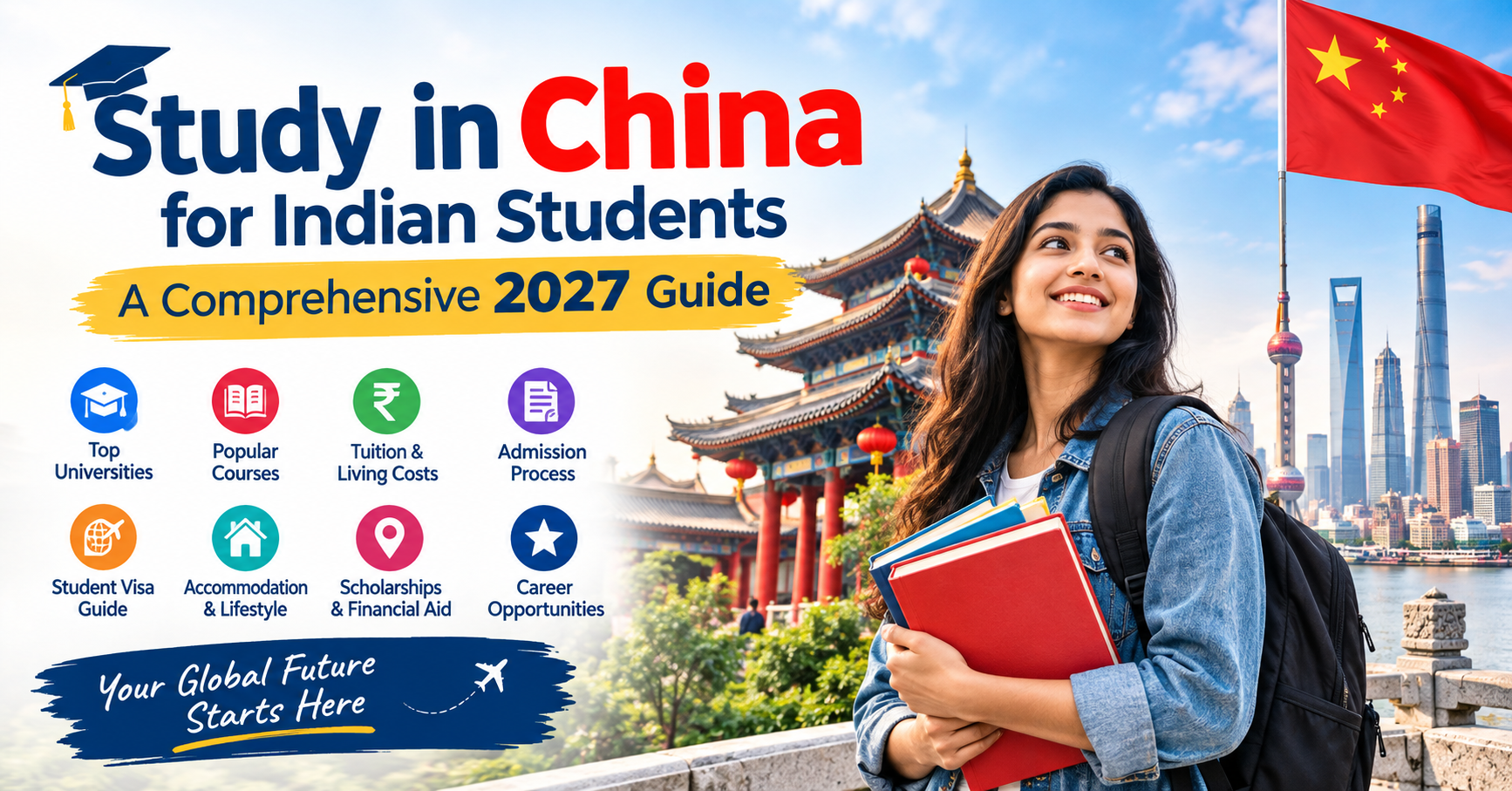
Study in China for Indian Students: A Comprehensive 2027 Guide
China continues to attract a growing number of Indian students seeking high-quality, affordable higher education. With strong global rankings in STEM and medicine, English-taught programs, generous scholarships, and relatively low living costs compared to Western destinations, it remains a practical and rewarding option. This expanded guide provides a structured overview with detailed headings, subheadings, and multiple comparison tables to help Indian students plan effectively for the 2026 intake and beyond.
Why Study in China? Key Advantages for Indian Students
1.1 Academic Quality and Global Rankings
Chinese universities have climbed rapidly in QS and other global rankings. Institutions such as Tsinghua and Peking University now rank among the world’s top 20–30. Strengths are particularly notable in engineering, computer science, AI, materials science, and clinical medicine.
1.2 Affordability Compared to Other Destinations
Tuition and living costs are substantially lower than in the USA, UK, Australia, or Canada. Many students complete a full degree (including living expenses) for the cost of one or two years at a private Indian or Western institution.
1.3 English-Taught Programs and Language Support
A large number of undergraduate and postgraduate programs, especially MBBS and engineering, are offered in English. Chinese language (HSK) training is often available or required later for clinical or professional practice.
1.4 Scholarships and Financial Support
The Chinese Government Scholarship (CSC) and numerous provincial/university awards can cover full or partial costs, making study nearly free for selected candidates.
1.5 Cultural and Career Exposure
Students gain exposure to the world’s second-largest economy, learn Mandarin, and build networks useful for careers in trade, technology, manufacturing, and research involving India–China engagement.
2. Popular Courses and Programs for Indian Students
2.1 Medicine (MBBS / Clinical Medicine)
The most popular choice. Six-year English-medium programs at MOE-approved universities. Graduates must pass FMGE or NExT and complete the required internship to practice in India.
2.2 Engineering and Technology
Civil, Mechanical, Electrical, Computer Science, AI, Data Science, and related fields. Strong research facilities and industry linkages.
2.3 Business, Economics, and Management
BBA, MBA, International Trade, and related programs. Useful given China’s role in global supply chains.
2.4 Other Growing Fields
- Chinese Language and Literature
- Pharmacy and Traditional Chinese Medicine
- Environmental Science and Renewable Energy
- Master’s and PhD programs across STEM and social sciences
Eligibility Criteria for Indian Students
3.1 General Requirements by Level
| Program Level | Academic Requirement | Typical Age Limit | Language Requirement | Additional Notes |
|---|---|---|---|---|
| Undergraduate (General) | Class 12 with relevant subjects | 17–25 years | English medium or IELTS 5.5–6.0 | Passport with 6+ months validity |
| MBBS | Class 12 PCB, 50% (Gen)/40% (Reserved) | 17–25 years | English; HSK-4 later for clinics | NEET qualified + NMC Eligibility Certificate before admission |
| Master’s | Bachelor’s degree (55–60%+) | Under 35 | IELTS 6.0 / TOEFL 80 or HSK 4–5 | Research proposal preferred for some |
| PhD | Master’s degree | Under 40 | Higher language scores + research plan | Supervisor acceptance often helpful |
3.2 Health and Other Requirements
- Foreigner Physical Examination Form (includes HIV, Hepatitis B, chest X-ray, etc.)
- Valid passport
- Police clearance certificate (in some cases)
- No serious criminal record or health conditions that prevent study
4. Top Universities and Popular Choices
4.1 Leading Comprehensive Universities
| Rank (Approx. QS 2026) | University | City | Strengths | Approx. Annual Tuition (CNY) |
|---|---|---|---|---|
| Top 20 | Tsinghua University | Beijing | Engineering, CS, AI | 26,000–68,000 |
| Top 20 | Peking University | Beijing | Medicine, Sciences, Humanities | 24,000–62,000 |
| Top 40 | Fudan University | Shanghai | Medicine, Business, IR | 22,000–75,000 |
| Top 50 | Zhejiang University | Hangzhou | Broad STEM & Medicine | 20,000–55,000 |
| Top 50 | Shanghai Jiao Tong University | Shanghai | Engineering, Medicine | 22,000–60,000 |
| University | City | Approx. Annual Tuition (CNY / INR) | Notes |
|---|---|---|---|
| Fudan University | Shanghai | 75,000 / ₹10+ lakh | Premium, strong hospitals |
| Zhejiang University | Hangzhou | 42,800 / ₹5.9 lakh | High ranking, good clinical exposure |
| Wuhan University | Wuhan | 40,000 / ₹5.5 lakh | Popular among Indians |
| Huazhong University of Science & Tech | Wuhan | 40,000 / ₹5.5 lakh | Solid facilities |
| Nanjing Medical University | Nanjing | 34,000 / ₹4.7 lakh | Good value, decent FMGE performance |
| China Medical University | Shenyang | 40,000 / ₹5.5 lakh | Long experience with international students |
| Jilin University | Changchun | 33,000 / ₹4.6 lakh | More affordable option |
5. Cost of Studying in China
5.1 Tuition Fee Ranges (Annual, Approximate 2026)
| Program Type | Chinese-Taught (CNY) | English-Taught (CNY) | Approx. INR Range |
|---|---|---|---|
| Bachelor’s (Humanities) | 15,000–25,000 | 20,000–35,000 | ₹2.3–5 lakh |
| Bachelor’s (Engineering) | 20,000–35,000 | 25,000–45,000 | ₹3–6.5 lakh |
| MBBS / Clinical Medicine | 30,000–50,000 | 33,000–75,000 | ₹4.5–10.5 lakh |
| Master’s | 25,000–40,000 | 30,000–50,000 | ₹3.5–7 lakh |
| PhD | 20,000–35,000 | 25,000–45,000 | ₹3–6.5 lakh |
5.2 Monthly Living Costs by City Tier
| City Tier / City | Monthly Budget (CNY) | Monthly Budget (Approx. INR) | Notes |
|---|---|---|---|
| Tier-1 (Beijing, Shanghai) | 3,500–6,000 | ₹40,000–70,000+ | Highest costs |
| Tier-2 (Guangzhou, Nanjing, Hangzhou) | 2,500–4,500 | ₹29,000–52,000 | Balanced |
| Inland / Affordable (Wuhan, Chengdu, Xi’an) | 2,000–3,500 | ₹23,000–40,000 | Best value |
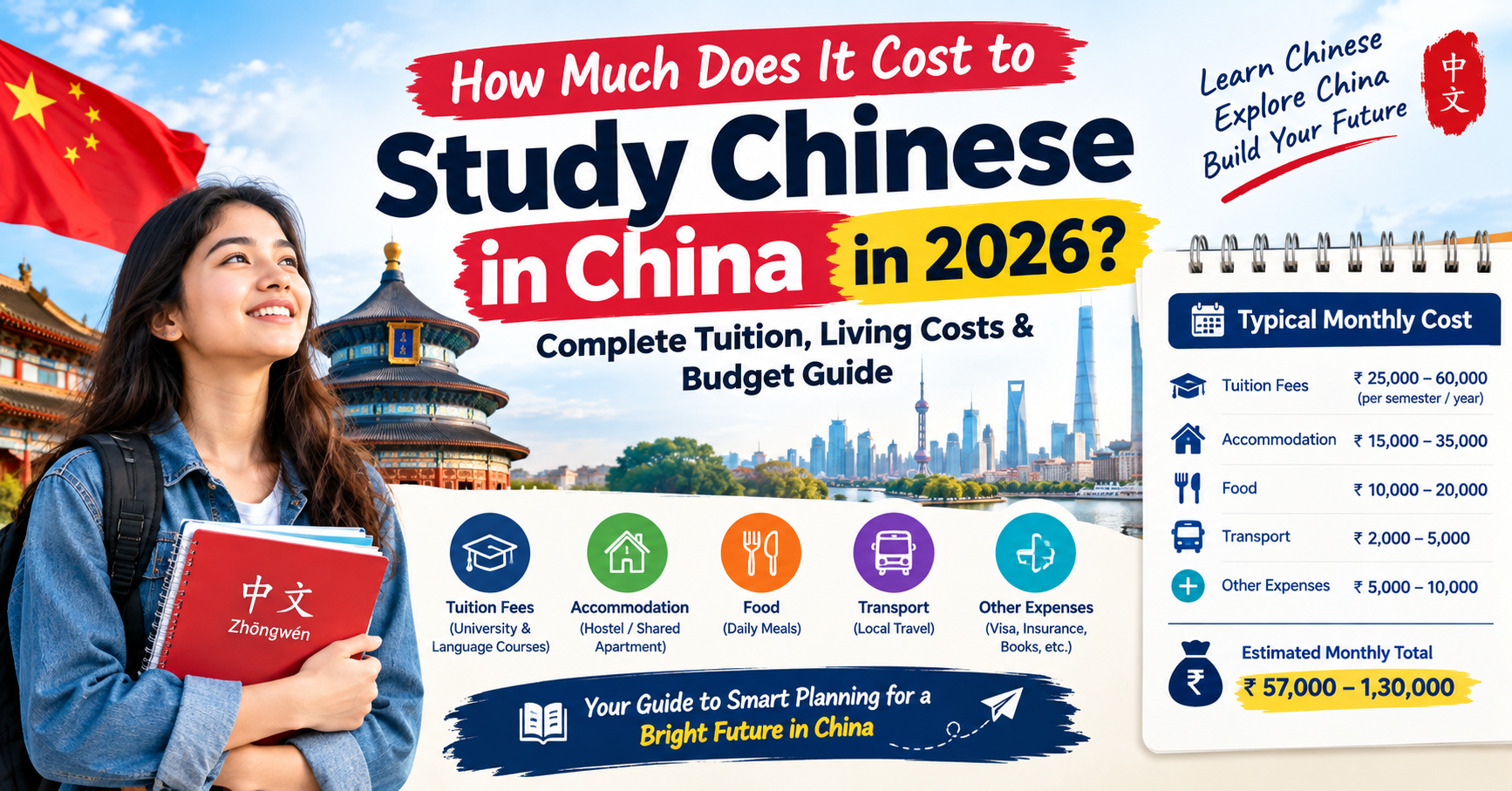
5.3 Sample Monthly Breakdown (Moderate Lifestyle)
| Expense Category | Inland City (CNY) | Tier-2 City (CNY) | Beijing/Shanghai (CNY) |
|---|---|---|---|
| Accommodation (Dorm/Shared) | 500–1,200 | 1,000–2,000 | 1,500–3,000 |
| Food | 800–1,300 | 1,000–1,800 | 1,500–2,500 |
| Transport | 100–200 | 150–300 | 200–400 |
| Phone + Internet | 50–100 | 80–150 | 100–200 |
| Miscellaneous | 300–600 | 400–800 | 500–1,000 |
| Total | 2,000–3,500 | 2,800–4,500 | 4,000–6,500 |
6. Scholarships for Indian Students
6.1 Chinese Government Scholarship (CSC / CGS)
| Degree Level | Monthly Stipend (CNY) | Coverage | Age Limit |
|---|---|---|---|
| Undergraduate | 2,500 | Full tuition + accommodation + insurance | Under 25 |
| Master’s | 3,000 | Full tuition + accommodation + insurance | Under 35 |
| PhD | 3,500 | Full tuition + accommodation + insurance | Under 40 |
6.2 Other Scholarship Options
- Provincial scholarships (Beijing, Shanghai, Jiangsu Jasmine, etc.)
- University merit scholarships
- Confucius Institute Scholarship (primarily language)
- MOFCOM scholarships (selected postgraduate programs)
Applications for CSC usually open from late year to March/April. Apply via the CSC portal and/or university portals. Strong academics, a clear study plan, and recommendation letters improve success rates.
7. Application Process Step by Step
7.1 Timeline Overview
- Research & shortlisting: September–December
- Document preparation: November–January
- Applications: December–April/May (varies by university)
- Admission results & JW forms: March–July
- Visa application: After receiving documents
- Arrival: August–September for main intake
7.2 Required Documents (Typical)
- Academic transcripts and certificates (notarized/apostilled)
- Passport copy
- Statement of Purpose / Study Plan
- Recommendation letters (2)
- Language proficiency proof
- Medical examination form
- NEET scorecard + NMC certificate (for MBBS)
- Passport-size photographs
- Financial proof or scholarship award letter
8. Student Visa Process (X1 and X2)
8.1 Visa Types Comparison
| Feature | X1 Visa | X2 Visa |
|---|---|---|
| Study Duration | More than 180 days | 180 days or less |
| Residence Permit | Required within 30 days of arrival | Not required |
| Typical Use | Degree programs, long language | Short courses, exchanges |
| Entry | Single entry initially | Single or double |
8.2 Key Visa Documents
- Valid passport
- Completed online application form (COVA)
- Original Admission Notice
- Original JW201 (scholarship) or JW202 (self-funded) form
- Physical examination record (X1)
- Photos and supporting documents as required by CVASC
Visa fees for Indians start around ₹2,900 for single entry (plus service charges). Apply at Chinese Visa Application Service Centres in major Indian cities.
9. Life as an Indian Student in China
9.1 Accommodation and Campus Facilities
Most universities provide international student dormitories (shared or single rooms) with basic furniture, internet, and shared kitchens/bathrooms in many cases.
9.2 Food and Daily Life
Campus canteens are inexpensive. Indian messes or restaurants exist near many medical universities. Learning basic Mandarin and using apps (WeChat, Alipay, Meituan, Didi) makes daily life smoother.
9.3 Challenges and How to Manage Them
- Language barrier outside English programs
- Homesickness and cultural adjustment
- Cold winters in northern cities
- Strict attendance and academic rules
- Preparation needed for FMGE/NExT after MBBS
10. Career Prospects After Graduation
10.1 Returning to India (Especially Medicine)
Pass FMGE or NExT + complete mandatory internship. Only MOE-listed university degrees qualify.
10.2 Opportunities in China or Globally
Technology, engineering, research, international business, and teaching Chinese. Mandarin proficiency is a strong advantage. Some students pursue further studies or work visas subject to regulations.
11. Practical Tips for Success
- Verify university recognition on official MOE, NMC, and Embassy of India Beijing sources.
- Apply early and to multiple universities (reach, match, safety).
- Budget for one-time costs (visa, flights, medical, initial setup).
- Start learning basic Chinese before departure.
- Join Indian student communities and alumni groups for real experiences.
- Keep all original documents and multiple photocopies.
12. Conclusion
Studying in China offers Indian students a combination of academic strength, cost-effectiveness, and international exposure that is difficult to match in many other destinations. Whether pursuing MBBS, engineering, business, or research degrees, careful selection of MOE-recognized institutions, proactive scholarship applications, and thorough preparation for the visa and cultural transition are essential. With updated information for 2026 and a structured approach using the tables and steps above, students and families can make informed decisions. Always cross-check the latest official guidelines from Chinese universities, the China Scholarship Council, Chinese Visa centres, and Indian regulatory bodies, as rules and fees can change. A well-planned journey to China can open significant academic and professional opportunities.