DELF Exam : Complete Guide to Levels, Syllabus, Fees & Exam Pattern
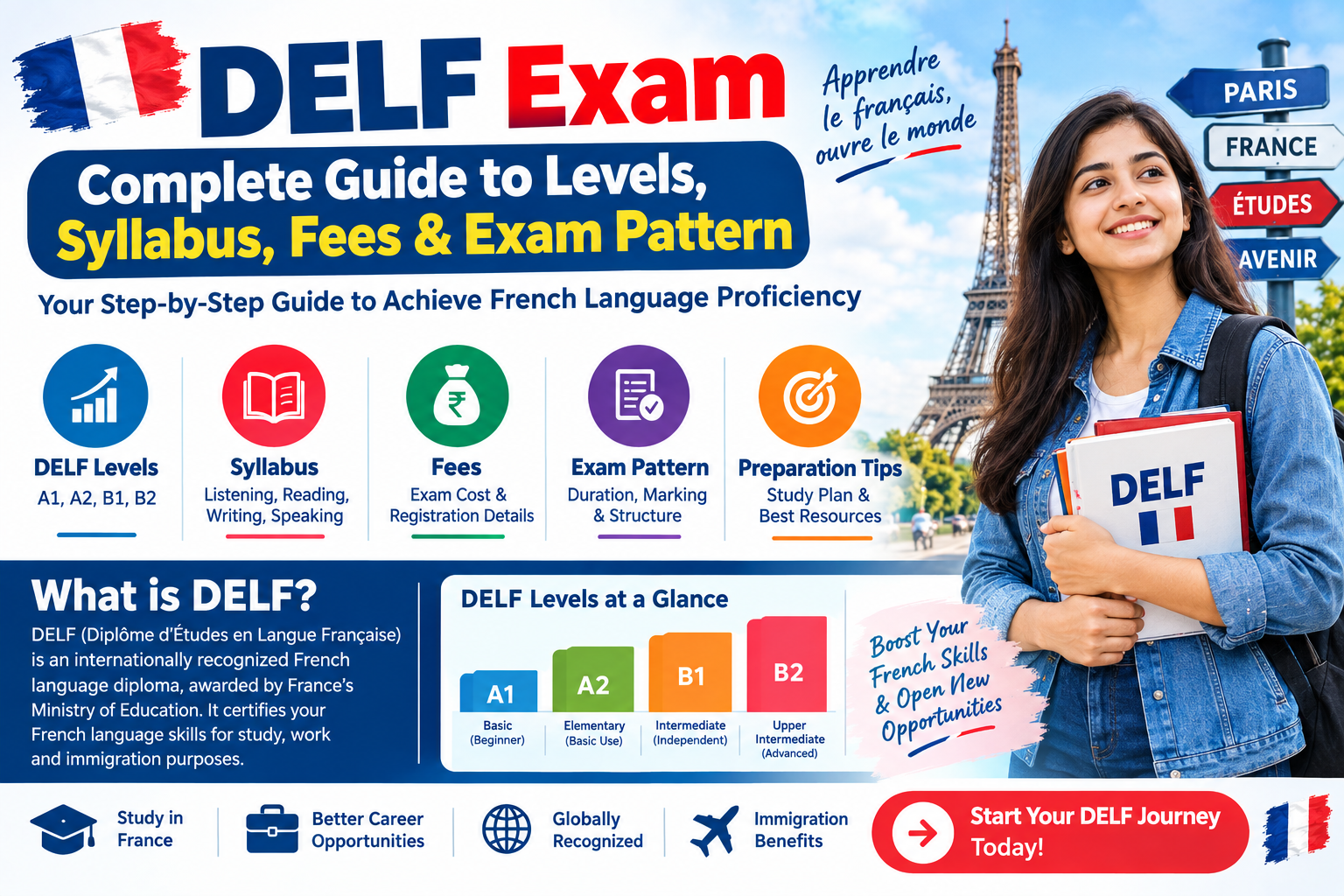
The DELF (Diplôme d’Études en Langue Française) is one of the most trusted official French-language qualifications in the world — and in 2026, it continues to be a go-to certification for students, professionals, and immigration applicants across India. Unlike temporary language scores, the DELF diploma is valid for life and is recognised internationally, which makes it a genuinely long-term investment rather than something you need to renew or retake periodically. This guide breaks down everything you need to know: levels, syllabus, exam pattern, scoring, fees in India, and how to prepare.
1. What Is the DELF Exam?
The DELF is an official French-language diploma issued by France’s Ministry of National Education, administered internationally by France Éducation international (FEI). It assesses the French language skills of non-native speakers across four independent levels — A1, A2, B1 and B2 — which correspond directly to the Common European Framework of Reference for Languages (CEFR).
Because each level is awarded as a separate diploma, you do not have to complete A1 before taking A2, B1, or B2 — you can register directly for whichever level matches your current French proficiency. This flexibility is one reason the DELF remains so popular: a working professional who already has intermediate French doesn’t need to “start from zero” just to get certified.
1.1 DELF vs DALF vs Other Variants
| Certification | CEFR Levels Covered | Who It’s For |
|---|---|---|
| DELF (tout public) | A1, A2, B1, B2 | General adult learners (17+) |
| DELF Junior/Scolaire | A1, A2, B1, B2 | Teenagers aged 11–17 (same structure, youth-focused topics) |
| DELF Prim | A1.1, A1, A2 | Children aged 7–11 |
| DALF | C1, C2 | Advanced learners progressing beyond DELF B2 |
| DILF | A1.1 only | Absolute beginners, introductory certificate |
The DELF and DALF together cover all six CEFR levels, with DALF C1 and C2 picking up where DELF B2 leaves off.
2. DELF Exam Levels Explained
2.1 DELF A1 — Entry Level
DELF A1 focuses on simple communication such as introducing yourself, understanding basic expressions, and exchanging straightforward everyday information. It’s the right starting point for absolute beginners who have just begun learning French.
2.2 DELF A2 — Elementary Level
DELF A2 builds on A1 foundations and evaluates the ability to communicate in practical, everyday situations, demonstrating that a candidate can participate in routine tasks requiring direct information exchange — things like shopping, asking directions, or simple workplace conversations.
2.3 DELF B1 — Threshold/Independent Level
DELF B1 represents an important milestone for independent users of the French language and is often a requirement for French citizenship applications. At this level, candidates handle tasks involving expressing opinions, describing experiences, and managing everyday work-related communication.
2.4 DELF B2 — Upper-Intermediate/Advanced Level
DELF B2 is the most demanding of the four and is increasingly significant in 2026, since France requires a B2 level for naturalization in several contexts. At B2, the candidate must deliver a 5-to-7-minute argued monologue and then debate it with two examiners, meaning a reliable grip on tense and mood matters far more than at lower levels.
2.5 Quick Reference: What Each Level Unlocks
| Level | Typical Use Case |
|---|---|
| A1 | Basic citizenship/orientation course validation |
| A2 | Residence card applications (as required by French authorities) |
| B1 | French nationality applications; workplace communication |
| B2 | Naturalization; university admission; strong CRS/immigration value |
3. DELF Exam Pattern & Structure (2026)
Every DELF level tests the same four skills — listening, reading, writing, and speaking — in the same order. Listening, reading, and writing are sat collectively in one session, while the oral exam is scheduled individually with an examiner.
3.1 Section-Wise Time Breakdown
| Level | Listening | Reading | Writing | Collective Total | Oral Exam |
|---|---|---|---|---|---|
| DELF A1 | 20 min | 30 min | 30 min | 1 h 20 min | 5–7 min |
| DELF A2 | 25 min | 30 min | 45 min | 1 h 35–1 h 40 | 6–8 min |
| DELF B1 | 25 min | 35–45 min | 45 min | 1 h 45–1 h 55 | 10–15 min |
| DELF B2 | 30 min | 60 min | 60 min | 2 h 30 min | Up to 20 min |
Two comprehension paper formats (“format 1” and “format 2 actualisé”) are currently both in circulation, which is why A2 and B1 show a time range rather than a single fixed duration — France Éducation international has stated both formats will remain valid for a few more years.
3.2 Oral Exam Preparation Time
Preparation time for the speaking section stays flat at 10 minutes from A1 through B1, then triples to 30 minutes at B2 — reflecting the jump in task complexity, since B2 candidates must plan and structure a full argued monologue before facing the examiners.
3.3 Minimum Word Count for Writing Tasks
| Level | Minimum Words Required (Writing Paper) |
|---|---|
| DELF A1 | 40 words |
| DELF B1 | 160 words |
| DELF B2 | 250 words |
(A2 asks for two shorter texts rather than one continuous piece, so it isn’t directly comparable on word count.)
4. DELF Syllabus: Skills Tested at Each Level
While the exact topics vary by level, the four core skill areas remain consistent throughout the DELF ladder:
4.1 Listening Comprehension
Candidates listen to short recordings — announcements, conversations, radio-style clips — and answer questions based on what they hear. Complexity and speaking speed increase significantly from A1 to B2.
4.2 Reading Comprehension
This section involves reading short texts (notices, emails, articles, or literary extracts at higher levels) and answering comprehension questions about content, tone, and intent.
4.3 Written Expression
Tasks range from filling out simple forms and writing short personal messages at A1, to composing structured argumentative essays and formal letters at B2.
4.4 Oral Expression
This is the only face-to-face component of the exam. It typically includes:
- A guided interview (introducing yourself, answering personal questions)
- An interactive role-play exercise
- At B2, an argued monologue followed by a debate with two examiners
5. DELF Scoring System
Each of the four papers is marked out of 25, for a total of 100 marks across the exam.
| Scoring Rule | Detail |
|---|---|
| Total marks | 100 (25 per section) |
| Passing score | 50/100 overall |
| Eliminatory condition | Any single paper scoring below 5/25 fails the candidate, regardless of total score |
| Validity | Lifetime — no expiry, ever |
| Retakes | No cap on the number of attempts |
This eliminatory rule is important and often overlooked: even a strong overall score won’t save you if you score below 5/25 in even one section, so balanced preparation across all four skills matters more than acing just one or two.
6. DELF Exam Fees in India (2026)
DELF fees in India are set within a national fee framework by the French Ministry of Education, but each Alliance Française centre sets its own local rate within that range — so prices can differ slightly between AF Delhi, AF Bombay, AF Lucknow, and other centres.
6.1 Approximate Fee Range by Level
| Level | Approximate Fee Range (INR) |
|---|---|
| DELF A1 | ₹6,500 – ₹11,210 |
| DELF A2 | ₹6,500 – ₹11,210 |
| DELF B1 | ₹7,000 – ₹13,265 |
| DELF B2 | ₹7,000 – ₹13,265 |
DELF exam fees in India for 2026 range from about ₹7,287 to ₹14,549 per level overall, with the exact amount depending on the level and whether the candidate is registering as an internal student (enrolled in the centre’s own courses) or as an external candidate. External candidates typically pay a higher rate — for instance, an external candidate taking A1 or A2 pays ₹11,210, while B1 and B2 cost ₹13,265 under the 2026 national fee structure. All published fees include GST, and there are no additional charges for certificates.
6.2 Important Fee Notes
- Each DELF level is a separate diploma, so if you want to take both A2 and B1 in the same year, you pay the full fee for each level separately.
- Internal candidates (those enrolled in a preparatory course at the same centre) often get a discounted rate compared to external candidates registering only for the exam.
- Always confirm the final fee directly with your chosen test centre before paying, since rates are revised periodically.
7. DELF Exam Registration & Sessions in 2026
DELF exams are conducted in multiple sessions throughout the year across Alliance Française centres and Institut français India locations. A typical 2026 session calendar looks like this:
| Session | Levels Offered | Registration Window |
|---|---|---|
| March Session | Tout Public (B1, B2, C1, C2) | 6 Feb – 23 Feb 2026 |
| June Session | Tout Public (A1, A2, B1, B2) | 15 May – 29 May 2026 |
| July Session | Tout Public & Junior (A1, A2, B1, B2) | 1 June – 30 June 2026 |
| November Session | Tout Public & Junior (A1, A2, B1, B2) | 9 Nov – 24 Nov 2026 |
Since registration windows are short and seats limited, candidates should register as early as possible within the open window, particularly for popular levels like B1 and B2.
8. DELF vs TCF/TEF Canada: Choosing the Right Exam
Many candidates confuse the DELF with TCF/TEF Canada since both certify French proficiency, but they serve different purposes:
| Factor | DELF | TCF/TEF Canada |
|---|---|---|
| Validity | Lifetime | Valid for 2 years only |
| Issued by | France Éducation international / French Ministry of Education | France Éducation international (TCF) / CCI Paris (TEF) |
| Primary use | Citizenship, residence permits, academic admissions, career | Canadian immigration (Express Entry, CRS points) |
| Retake flexibility | Unlimited retakes, any level | Must retake within validity window if score expires |
| Levels | A1–B2 (DELF) + C1–C2 (DALF) | Scored against CLB, not CEFR directly |
If Canadian PR is your goal, TCF Canada or TEF Canada — not DELF — is the exam IRCC actually uses for Express Entry bonus points, since it maps directly to CLB levels. However, a strong DELF B2 is roughly comparable in proficiency terms and is a good indicator of readiness before attempting the Canada-specific exams.
9. How to Prepare for the DELF Exam
9.1 Build a Level-Appropriate Study Plan
| Starting Point | Target Level | Suggested Prep Duration |
|---|---|---|
| Complete beginner | A1/A2 | 3–5 months |
| Elementary French | B1 | 4–6 months |
| Intermediate French | B2 | 3–5 months |
9.2 Preparation Tips by Skill
- Listening: Practice with authentic French audio/video at your target level daily; focus on catching key details rather than every single word.
- Reading: Read short French texts (news snippets, emails, notices) and practice skimming for gist versus scanning for specific information.
- Writing: Practice structured writing under timed conditions, respecting the minimum word counts for your level, and get feedback from a tutor on grammar and coherence.
- Speaking: Since this is the only face-to-face component, rehearse guided interviews and role-plays out loud, ideally with a tutor who can simulate examiner-style questioning.
9.3 Where to Prepare
Most candidates prepare either directly through Alliance Française centres (which also administer the exam) or through independent French-language institutes offering DELF-specific coaching, mock tests, and structured level-wise batches — both online and offline options are widely available across Indian cities.
10. Final Takeaways
The DELF remains one of the most valuable, lifetime-valid French certifications available to Indian learners in 2026 — whether the goal is studying in France, meeting residency/citizenship requirements, or simply strengthening a resume for bilingual roles. Since each level is an independent diploma with its own fee, timing, and difficulty, it’s worth honestly assessing your current French level before registering, rather than defaulting to A1 or overreaching for B2 without adequate preparation. Keep an eye on registration windows, budget for the level-appropriate fee, and remember: the 5/25 minimum-per-section rule means balanced preparation across listening, reading, writing, and speaking always beats specializing in just one skill.