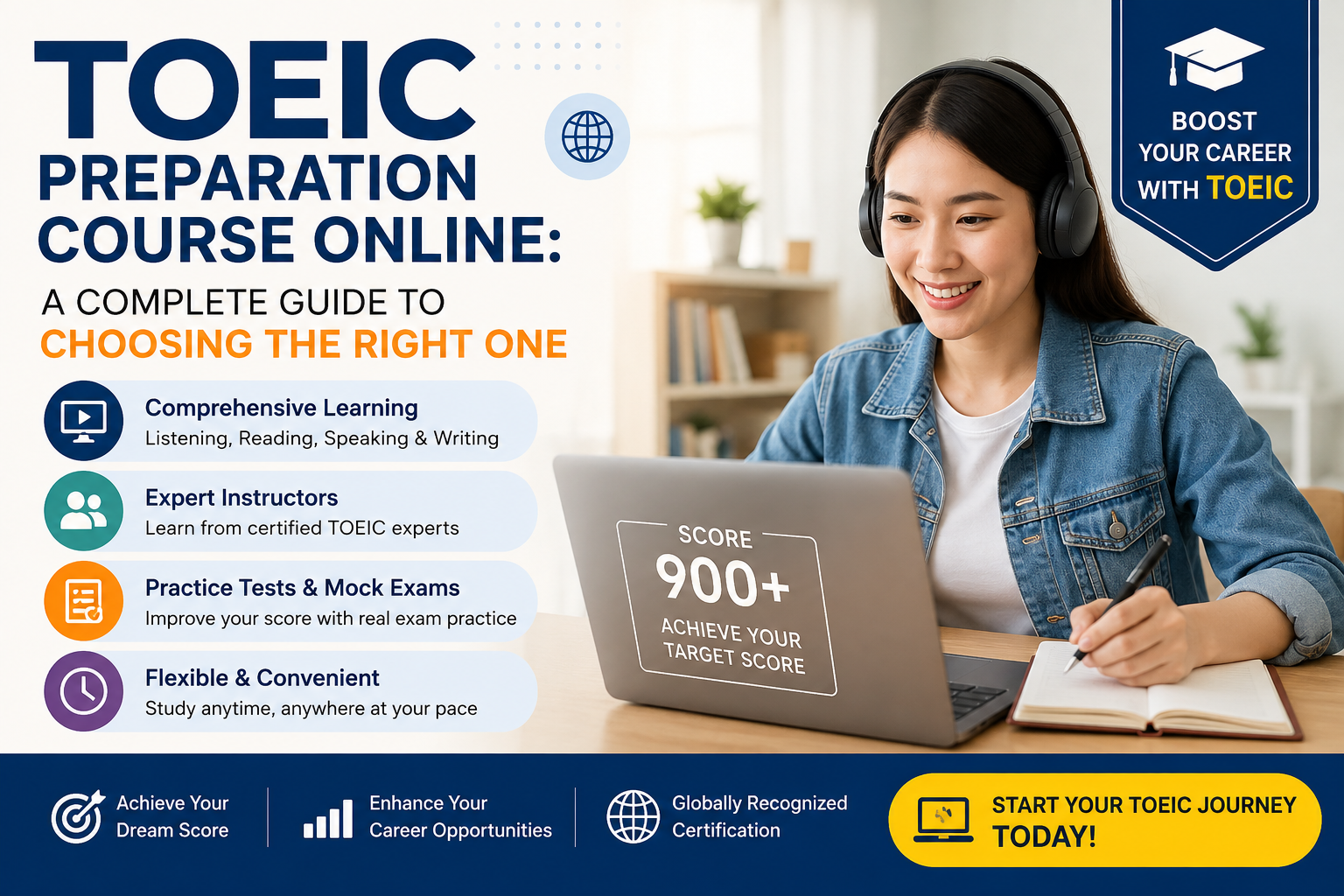
TOEIC Preparation Course Online
English proficiency scores have become a quiet but decisive factor in how companies hire, promote, and deploy employees across borders. Among the standardised tests employers rely on, TOEIC has become one of the most widely accepted, and a growing number of students and working professionals are now looking for a TOEIC preparation course online rather than a fixed classroom program. The flexibility, self-paced structure, and access to digital mock tests make online preparation genuinely competitive with in-person coaching — but only when the course is chosen carefully.
This guide covers what a TOEIC preparation course online should actually include, how to evaluate one before you enrol, and how to get real value out of it once you start.
What Is TOEIC, and Why Does Preparation Matter?
TOEIC — the Test of English for International Communication — is developed by ETS, the organisation also responsible for TOEFL. Unlike academic English tests, TOEIC is built around workplace and business communication: reading a company memo, understanding a voicemail, responding to a colleague in a meeting, or writing a professional email. It’s used by employers, corporate training programmes, and some universities in more than 160 countries to evaluate how ready a candidate is to function in an English-speaking professional environment.
The test itself is split into two separate assessments:
- TOEIC Listening and Reading Test — 100 Listening questions (about 45 minutes) and 100 Reading questions (about 75 minutes), each section scored from 5 to 495, combining into a total score between 10 and 990.
- TOEIC Speaking and Writing Tests — 11 Speaking questions (about 20 minutes) and 8 Writing questions (about 1 hour), each section scored from 0 to 200 and reported separately.
Because scoring is broken down by skill rather than given as a single blended number, effective preparation has to address Listening, Reading, Speaking, and Writing individually — which is exactly where a structured course, rather than casual self-study, tends to make the biggest difference.
Why More Candidates Are Choosing Online TOEIC Preparation
A decade ago, most serious exam preparation happened in a physical classroom. That’s shifted significantly, and for TOEIC specifically, online preparation now offers a few clear advantages:
1. Schedule flexibility. Most TOEIC candidates are either working professionals or students juggling other commitments. Online courses let you study early morning, late evening, or in fragmented sessions across the day, rather than committing to a fixed classroom slot.
2. Digital-native test format. TOEIC’s Speaking and Writing sections are already computer-delivered, with responses recorded and typed rather than spoken face-to-face or written by hand. Practising in a similar digital environment — speaking into a microphone under a timer, typing timed responses — builds familiarity that classroom-only practice doesn’t fully replicate.
3. Repeatable mock tests. Online platforms typically offer a bank of full-length practice tests that can be retaken and reviewed as many times as needed, which is harder to replicate in a fixed classroom schedule.
4. Access to specialised instructors regardless of location. Online courses aren’t limited by geography, so candidates can access instructors and course material built specifically around TOEIC, rather than a general spoken-English program adapted for test prep.
5. Often more affordable. Without the overhead of physical classroom space, many online TOEIC preparation courses are priced more competitively than in-person coaching of comparable quality.
That said, online preparation isn’t automatically better — a poorly structured online course, or one with outdated material, can leave a candidate just as underprepared as a weak classroom program. The next section covers what actually separates a strong course from a generic one.
What a Good TOEIC Preparation Course Online Should Include
1. A Proper Diagnostic Assessment
Before any structured learning begins, a good course should place you through a diagnostic test that separately evaluates Listening, Reading, Speaking, and Writing. This isn’t just a formality — it determines whether your study time should go toward vocabulary building, timing strategy, grammar fundamentals, or spoken fluency. Courses that skip this step and put every learner through an identical syllabus tend to waste a significant portion of the available study time.
2. Section-Wise, Skill-Specific Modules
Because TOEIC scores each skill separately, your course material should too. Look for:
- Listening modules built around business dialogues, voicemails, and short talks in the same style and pacing as the real exam audio — including a mix of American, British, and Australian accents, since the actual test uses all three.
- Reading modules that specifically train skimming and scanning strategies for incomplete-sentence questions, text completion, and comprehension passages, with an emphasis on time management rather than just vocabulary recall.
- Speaking modules that include recorded response practice, since the real test requires speaking clearly into a microphone under a strict timer — a very different experience from a live conversation, and one that needs its own practice.
- Writing modules covering both the shorter sentence-writing tasks and the longer opinion essay and email-response tasks, with structural guidance rather than just grammar correction.
3. Realistic, Timed Mock Tests
Time pressure is one of the biggest score-limiters in TOEIC, particularly in the Reading section, where candidates frequently run out of time before completing the final comprehension passages. A strong online course should include multiple full-length mock tests, ideally built from real exam-style questions, that replicate the actual timing exactly — not shortened or self-paced versions that don’t build genuine time-management skill.
4. Individual Feedback on Speaking and Writing
Because Speaking and Writing are evaluated on nuance — pronunciation, coherence, task completion, grammatical range — generic score reports aren’t enough. Look for a course that provides detailed, individualised feedback on your recorded speaking responses and written essays, whether from a live instructor or a well-calibrated AI-assisted review system, rather than just a numerical score with no explanation.
5. Progress Tracking and Score Prediction
Better online courses track your performance across practice sessions and mock tests over time, showing which question types you’re consistently missing and estimating your likely score range. This kind of tracking helps you see whether your preparation is actually working before you commit to a real test date, rather than guessing based on how confident you feel.
6. Updated, Exam-Accurate Material
ETS periodically refreshes TOEIC question styles to reflect how English is used in real modern workplaces — including natural speech patterns like contractions and sentence fragments in the Listening section. A course built on outdated material can leave you underprepared for question types that appear on the current version of the exam, so it’s worth confirming that course content reflects the present-day test format before enrolling.
How to Evaluate a TOEIC Preparation Course Before Enrolling
With dozens of online options available — from standalone apps to full instructor-led programs — a short evaluation checklist helps narrow the choice:
- Does it offer a free trial or sample lesson? This lets you judge teaching quality and platform usability before paying.
- Is there a placement or diagnostic test at the start? Courses without one are less likely to be personalised to your actual weak areas.
- How many full-length mock tests are included? More than two or three is a reasonable minimum for meaningful timing practice.
- Is feedback on Speaking and Writing individualised, or just automated scoring with no explanation? Detailed feedback matters more for these sections than for Listening and Reading.
- Are instructors specifically trained in TOEIC, or is this a general English course repackaged for test prep? TOEIC has its own question patterns and vocabulary focus that differ from general English fluency courses.
- What do verified student reviews say about score improvement, not just teaching style? Course marketing often emphasises engagement and convenience — actual score outcomes are a better indicator of effectiveness.
- Is the pricing structure clear, including whether mock tests, feedback sessions, or extended access cost extra? Some platforms charge separately for full-length practice tests or one-on-one review sessions.
Self-Paced vs. Instructor-Led Online Courses
Online TOEIC preparation generally falls into two broad formats, and choosing between them depends on your learning style and how much external accountability you need.
Self-paced courses (app-based or pre-recorded video modules) work well for disciplined learners who can maintain a consistent study schedule without external deadlines. They’re typically more affordable and allow complete flexibility in timing, but they usually offer limited or automated feedback on Speaking and Writing responses.
Instructor-led online courses (live sessions via video call, either one-on-one or in small groups) suit learners who benefit from real-time correction, structured deadlines, and the ability to ask questions as they come up. These tend to cost more but generally produce more personalised feedback, particularly for the productive skills — Speaking and Writing — where nuance matters most.
Many strong programs now combine both: self-paced modules and mock tests for Listening and Reading practice, paired with live or asynchronous instructor feedback specifically for Speaking and Writing responses. This hybrid structure tends to offer the best balance of flexibility and personalised guidance.
How Long Should Your Course Preparation Take?
Preparation timelines depend on your starting level and target score, but as a general guide:
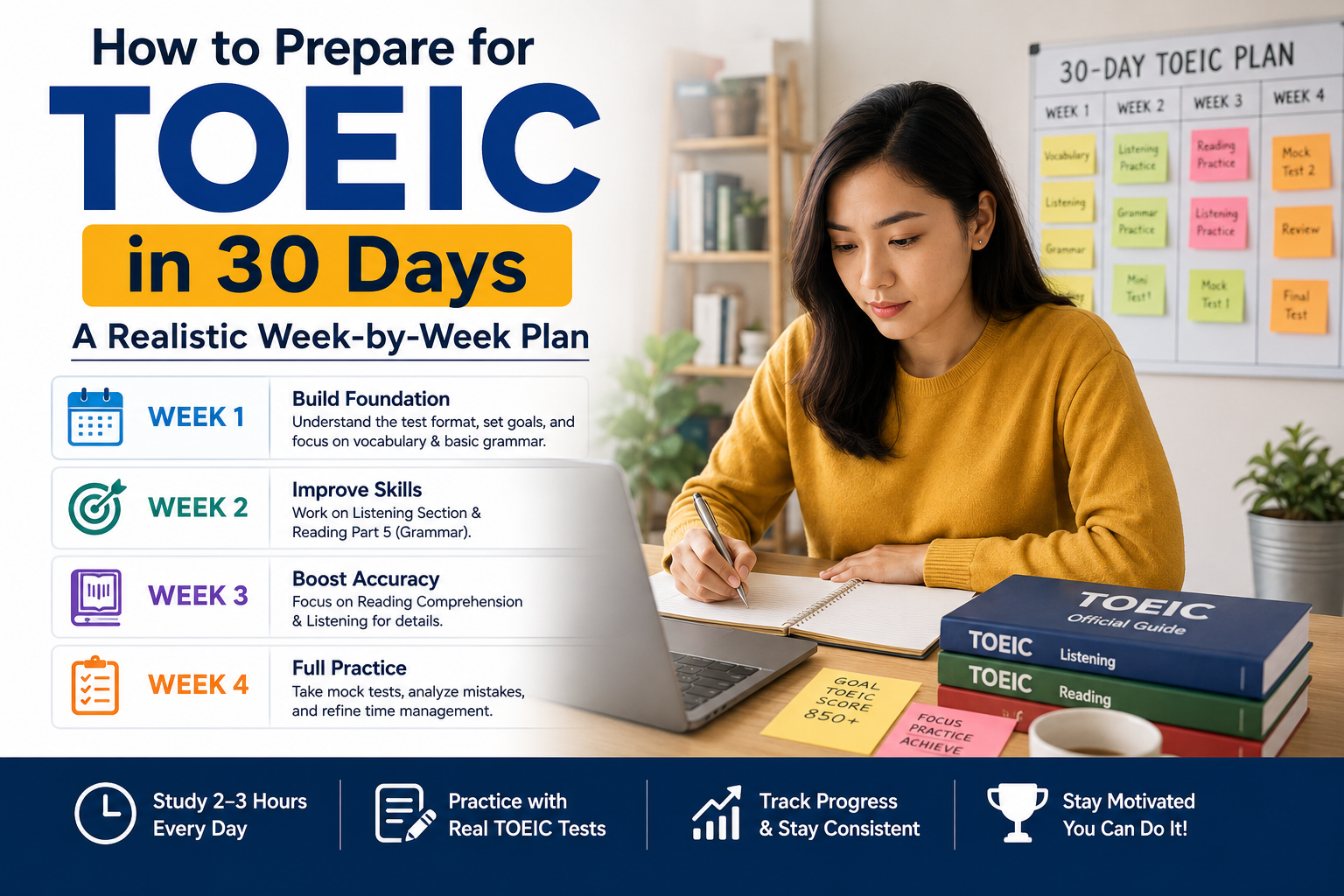
- Candidates already comfortable with workplace English typically need 3 to 5 weeks of focused online practice, concentrating on format familiarity, timing, and mock tests.
- Candidates who need to build grammar, vocabulary, or spoken fluency alongside test strategy generally benefit from 6 to 10 weeks.
- Candidates targeting a specific high score for a job or programme requirement should plan for extra time to take and review multiple mock tests, since consistent improvement tends to come from analysing mistakes across several practice attempts rather than a single study push before the exam.
A well-structured course should help you set this timeline based on your diagnostic result, not push a fixed course length onto every learner regardless of starting point.
Common Mistakes Candidates Make with Online TOEIC Prep
- Choosing a course based on price alone. The cheapest option often skips individualised feedback on Speaking and Writing, which are exactly the sections that benefit most from expert review.
- Skipping the diagnostic test. Jumping straight into generic lessons wastes time on areas you may already be strong in.
- Avoiding timed mock tests until the very end. Timing pressure needs repeated practice throughout preparation, not just in the final week.
- Treating Speaking practice like casual conversation. The Speaking section rewards structured, complete responses — candidates who don’t practise this specific skill often underperform relative to their actual spoken fluency.
- Not reviewing mistakes carefully. Simply taking more mock tests without analysing why specific questions were missed rarely leads to meaningful score improvement.
Who Benefits Most from a TOEIC Preparation Course Online?
Online TOEIC preparation isn’t a one-size-fits-all format, but a few groups tend to see particularly strong results from it:
- Working professionals with unpredictable schedules, who can’t commit to a fixed weekly classroom slot but can consistently find 45–60 minutes a day at varying times.
- Candidates based outside major cities, where in-person TOEIC-specialised coaching may not be easily available, but strong online instructors and platforms are accessible regardless of location.
- Self-motivated learners who prefer working through structured modules at their own pace and revisiting difficult sections as many times as needed, rather than moving at a fixed classroom speed.
- Candidates who have already studied English formally and mainly need targeted test-strategy training, timing practice, and mock exams rather than foundational language instruction.
- Professionals preparing while travelling or relocating, since online courses remain accessible without needing to switch physical coaching centres.
Candidates starting from a genuinely low proficiency level, needing substantial foundational grammar and vocabulary building, tend to benefit more from an instructor-led online course, or a hybrid of online and in-person coaching, than from a fully self-directed app-based course.
Technology and Tools to Look For
Because TOEIC Speaking and Writing are already delivered and scored digitally, the technology behind an online preparation course matters more than it might for other subjects. A few features worth checking for:
- Speech recognition and pronunciation feedback for Speaking practice, which can flag pacing, clarity, and fluency issues between live instructor sessions.
- Timed test simulators that replicate the actual on-screen interface and countdown format of the real TOEIC test, so there are no surprises on exam day.
- Written response analysis tools that check grammar, structure, and task completion for the email-response and essay-writing tasks, ideally combined with human review rather than automated scoring alone.
- Mobile access, since many working professionals fit in short study sessions during commutes or breaks rather than sitting at a desktop computer.
- Score-prediction dashboards that translate mock test performance into an estimated TOEIC score range, helping you judge readiness before booking the actual exam.
None of these tools replace genuine instructional quality, but they meaningfully speed up the feedback loop between practice and improvement — which matters a great deal when working within a limited preparation window.
Building a Study Routine Around Your Online Course
Enrolling in a course is only the starting point — how consistently you use it determines the outcome. A few habits tend to separate candidates who see real score improvement from those who don’t:
- Set a fixed daily or near-daily study slot, even if short, rather than relying on irregular long sessions. Consistency matters more than total hours for skill-based tests like TOEIC.
- Treat every mock test as a full simulation, including sitting through the entire timed duration without pausing, since building stamina and pacing is part of what mock tests are meant to train.
- Review mistakes the same day you make them, while the reasoning is still fresh, rather than letting a backlog of unreviewed practice tests build up.
- Alternate receptive and productive practice, since focusing only on Listening and Reading (which are easier to self-study) at the expense of Speaking and Writing often leaves candidates underprepared for sections that carry equal weight with many employers.
- Track your own progress alongside the course’s built-in tracking, noting which specific question types keep tripping you up, so you can flag them for extra review or instructor feedback.
Frequently Asked Questions
Is an online TOEIC preparation course as effective as in-person coaching? For most candidates, yes — provided the course includes proper diagnostic testing, timed mock exams, and individualised feedback on Speaking and Writing. The format matters less than whether these core components are present.
How much does a TOEIC preparation course online typically cost? Costs vary widely depending on whether the course is self-paced or instructor-led, and how many mock tests and feedback sessions are included. It’s worth comparing what’s actually bundled into the price rather than comparing headline costs alone.
Can I prepare for TOEIC using only free resources online? Free resources can help with vocabulary building and basic format familiarity, but they rarely offer the personalised feedback on Speaking and Writing, or the volume of realistic timed mock tests, that a structured paid course provides.
Do I need separate preparation for the Speaking and Writing tests? Yes. Since Listening and Reading are tested separately from Speaking and Writing, and many candidates only need one or the other depending on their employer’s requirement, it’s worth confirming which test you need before choosing a course, so you’re not paying for preparation you don’t need.
How do I know if an online course’s material reflects the current TOEIC format? Check whether the provider references recent TOEIC updates — such as natural speech patterns and contractions in Listening — and avoid courses built entirely on older practice material that may not reflect current question styles.
Final Thoughts
A good TOEIC preparation course online should function less like a generic English class and more like a targeted training programme: a diagnostic to identify weak areas, skill-specific modules for each of the four sections, enough full-length timed mock tests to build genuine exam-day pacing, and individualised feedback on Speaking and Writing responses. Before enrolling anywhere, ask to see a sample lesson, confirm how mock tests and feedback are structured, and check that the course material reflects the current TOEIC format. Choosing carefully at this stage makes a bigger difference to your final score than almost any other decision in your preparation.








Please share your valuable inputs