How to Prepare for TOEIC in 30 Days : A Realistic Week-by-Week Plan
Not everyone has three months to prepare for the TOEIC test. Whether you have a job deadline, a placement drive, or a client deputation coming up, 30 days is enough time to see a meaningful score improvement — as long as your preparation is structured rather than random. This guide breaks down exactly how to use a 30-day window to prepare for TOEIC, based on how the test is actually structured and scored.
Step 1: Take a Full Diagnostic Test Before You Start
Before opening a single vocabulary list, take one full-length TOEIC practice test under real timing conditions. This tells you two things: your current baseline across Listening, Reading, Speaking, and Writing, and which sections are pulling your score down the most. Without this step, it’s easy to spend a month studying grammar you already know while ignoring the timed-reading pressure that’s actually costing you marks.
Since TOEIC scores Listening and Reading from 5 to 495 each (combined 10–990) and Speaking and Writing from 0 to 200 each, your diagnostic result should tell you not just an overall number but which specific section needs the most attention in the days ahead.
Step 2: Build Your 30-Day Framework
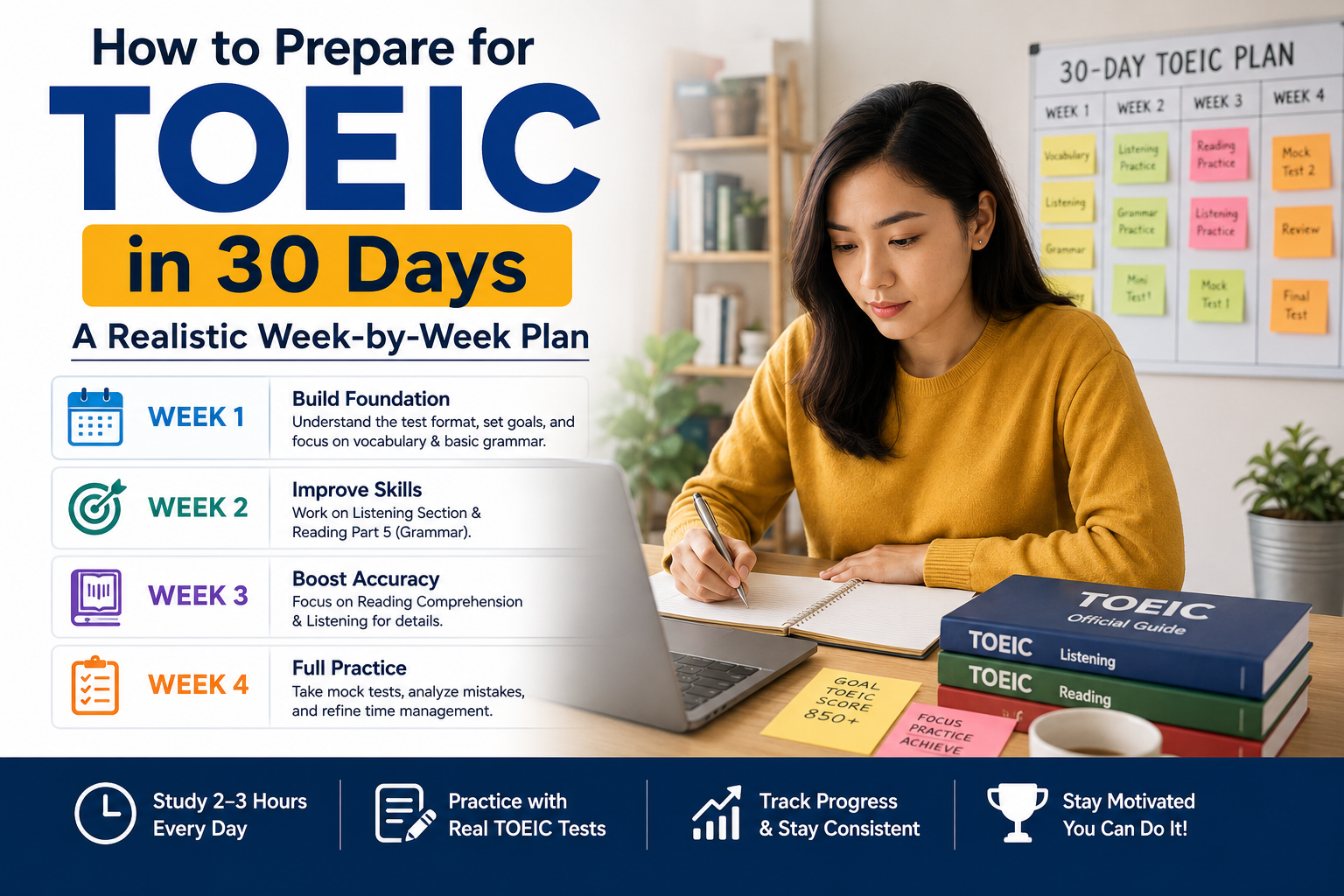
A 30-day plan works best when it’s split into four phases rather than treated as one long, undifferentiated study block.
Week 1: Foundations and Format Familiarity
Spend this week getting comfortable with the exam itself — question types, timing, and instructions — rather than trying to master content. Many candidates lose easy marks simply because they’re reading instructions for the first time on test day.
- Review the format of all four sections (Photographs and Question-Response in Listening; Incomplete Sentences and Text Completion in Reading; photo description and opinion tasks in Speaking; email response and essay tasks in Writing).
- Start a daily vocabulary routine — aim for 15–20 new business and workplace words a day, since TOEIC vocabulary is drawn heavily from office, travel, and everyday commercial contexts rather than academic language.
- Do one short, timed listening exercise and one short, timed reading passage daily to start training your pacing early.
Week 2: Targeted Practice on Weak Areas
Using your diagnostic results, dedicate this week to your two weakest sections.
- If Reading is weak, practise Part 7 comprehension passages under a strict time limit — this is where most candidates run out of time on the actual exam.
- If Listening is weak, practise with varied accents (American, British, Australian), since TOEIC audio deliberately mixes these.
- If Speaking is weak, record your responses to practice prompts and listen back for clarity, pacing, and completeness rather than just grammar.
- If Writing is weak, practise structuring a professional email response and an opinion essay, focusing on organisation before polishing vocabulary.
Keep vocabulary review going daily, but shift the bulk of your study time toward these targeted drills.
Week 3: Mixed Practice and Mock Tests
By week three, move from isolated section practice to combined, timed practice sets that mimic the real test experience.
- Take at least one full-length practice test this week under strict exam conditions — no pausing, no dictionary, timed exactly as the real test.
- Review every mistake individually and note whether it was a content gap, a timing issue, or a misread question — each requires a different fix.
- Continue daily vocabulary and one short speaking/writing drill to keep productive skills sharp.
Week 4: Full Simulation and Review
The final week should shift toward consolidation rather than new material.
- Take one more full-length mock test early in the week, ideally at the same time of day as your actual exam slot.
- Spend the remaining days reviewing your error patterns from all previous mock tests rather than cramming new vocabulary.
- Reduce study intensity in the final two to three days before the exam — light review only, plus rest, since fatigue affects concentration and speaking fluency more than most candidates expect.
- Confirm test-day logistics (test centre location, required ID, arrival time) early in the week so nothing is left to the last day.
Daily Study Structure That Actually Works
For most working professionals and students, 60–90 minutes of focused daily study over 30 days produces better results than irregular, longer sessions on weekends only. A simple daily structure that fits this window:
- 20 minutes: vocabulary and grammar review
- 20 minutes: timed listening or reading practice
- 15–20 minutes: speaking or writing practice (alternate days)
- 10 minutes: reviewing yesterday’s mistakes
On busier days, protect at least the vocabulary and one timed practice block rather than skipping the day entirely — consistency matters more than session length for a test like TOEIC.
Common Mistakes to Avoid in a 30-Day Plan
- Studying everything equally. A 30-day window is too short to treat all four skills as equal priorities — let your diagnostic result guide where the extra time goes.
- Skipping timed practice. Untimed practice builds accuracy but not exam-day pacing, which is where many otherwise well-prepared candidates lose marks.
- Ignoring the Speaking and Writing sections. Candidates often over-focus on Listening and Reading because they’re easier to self-study, then feel unprepared for the productive sections, which are scored just as seriously by employers.
- Cramming in the final days. Heavy last-minute study tends to increase exam-day anxiety and fatigue rather than adding meaningful score gains — the final 48 hours are better spent on light review and rest.
When 30 Days Isn’t Quite Enough
If your diagnostic test shows a large gap between your current level and your target score — for example, needing several hundred points of combined improvement rather than a modest increase — a 30-day self-study plan may need to be supplemented with structured coaching. A coaching program can compress the improvement timeline through personalised feedback on Speaking and Writing responses, guided mock test reviews, and a study plan tailored to your specific weak areas, which is difficult to replicate through self-study alone.
Final Thoughts
Thirty days is a realistic window to prepare for TOEIC if you approach it in phases: format familiarity first, targeted weak-area practice next, mixed timed practice after that, and a final week of simulation and rest. The candidates who see the biggest score jumps in a month aren’t necessarily the ones who study the most hours — they’re the ones who study the right sections, under real timing conditions, and review their mistakes closely enough to actually fix them before test day.