Online Korean Language Courses : Your Complete Guide to Learning Korean from Home
Korean has quietly become one of the most in-demand languages in the world. Between K-dramas taking over streaming platforms, K-pop dominating global charts, and South Korea’s growing influence in tech, business, and gaming, more people than ever want to actually understand what’s being said — not just read the subtitles. If you’ve been thinking about learning Korean, there has never been a better time to start, and there’s never been an easier way to do it than through Online Korean language courses.
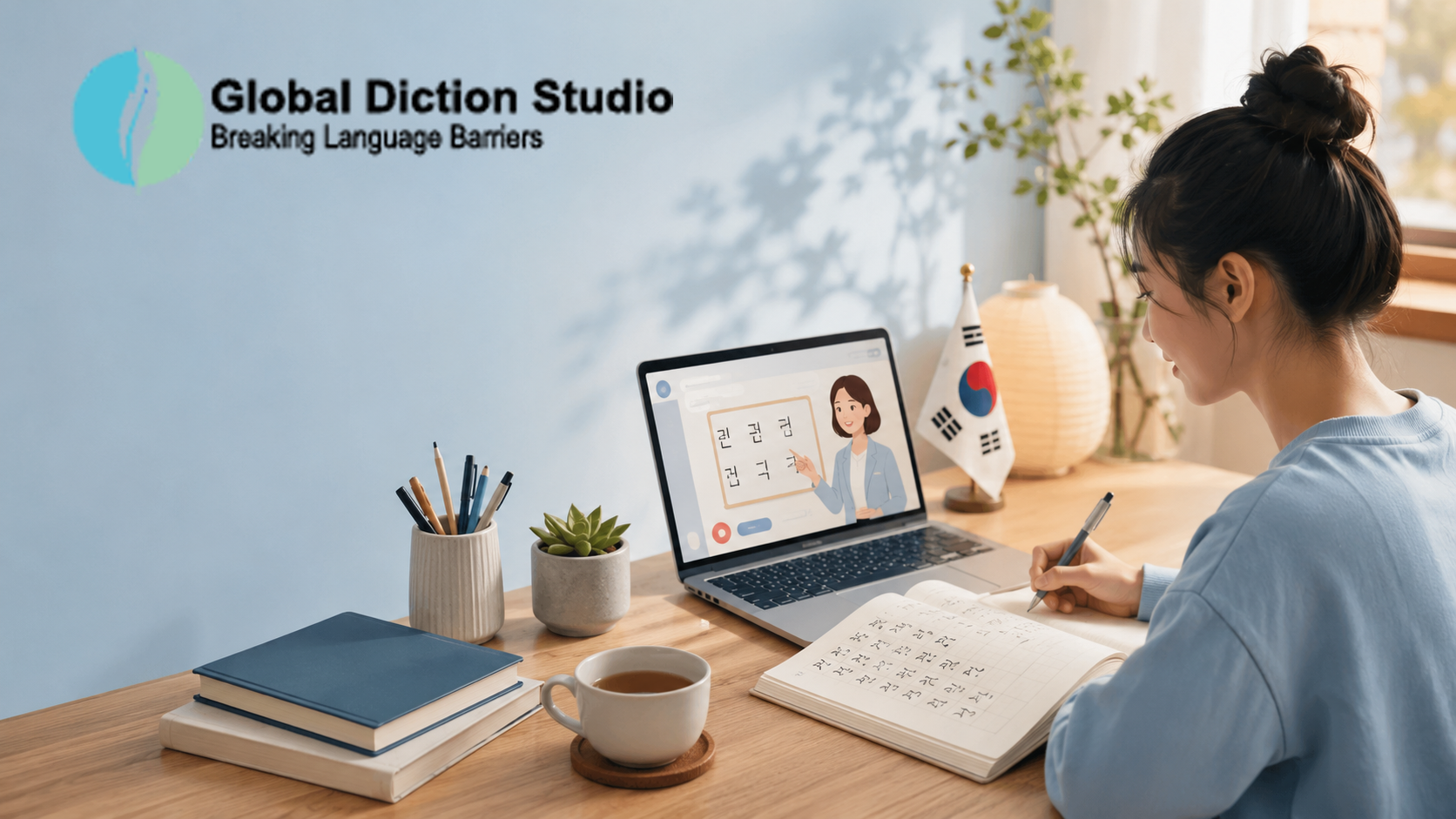
At Global Diction Studio, we’ve built our online Korean language courses around one simple idea: learning a new language should feel achievable, not overwhelming. This guide walks you through why online Korean language courses work, what to look for in a good program, and how to actually make progress — whether you’re a complete beginner or someone who’s tried (and stalled out) before.
Why Learn Korean in 2026?
Korean isn’t just trending — it’s genuinely useful. Here’s why so many learners are picking it up right now.
Cultural connection. If you’re into Korean cinema, dramas, variety shows, or music, learning the language changes the experience entirely. Jokes land differently, wordplay makes sense, and you stop relying on translations that inevitably lose nuance.
Career opportunities. South Korea is a major player in electronics, automotive manufacturing, entertainment, and biotechnology. Companies like Samsung, LG, Hyundai, and a growing list of Korean startups operate globally, and employees who can communicate in Korean — even at a conversational level — stand out.
Travel and daily life. Seoul, Busan, and Jeju Island are increasingly popular destinations. Even basic Korean makes ordering food, navigating public transport, and connecting with locals far smoother.
Cognitive and personal growth. Learning any new language sharpens memory, improves multitasking, and builds confidence. Korean, with its logical writing system and structured grammar, is a particularly rewarding language to master.
A genuinely learnable alphabet. Unlike Chinese characters or Japanese kanji, Korean uses Hangul — a phonetic alphabet created in the 15th century specifically to be easy to learn. Most students pick up the basics of reading Hangul within a few hours, which gives an early confidence boost that keeps you motivated.
Why Choose Online Korean Language Courses Over Traditional Classes?
Online learning isn’t just a convenient alternative to in-person classes anymore — for many learners, online Korean language courses are actually the better option. Here’s why.
Flexibility That Fits Your Life
Traditional language schools require you to show up at a fixed time, often in a fixed location. Online courses flip that model. You can study early in the morning before work, during a lunch break, or late at night after the kids are asleep. Lessons can be paused, replayed, and revisited as many times as you need — something a physical classroom simply can’t offer.
Learn at Your Own Pace
Not everyone learns at the same speed, and that’s fine. Some students want to move quickly through beginner material because they already have exposure to the language through media or heritage. Others want to slow down and really absorb grammar before moving forward. A good online course lets you set that pace yourself instead of being dragged along by a group schedule.
Access to Better Resources
Online platforms can combine video lessons, interactive exercises, audio drills, live tutoring, and community practice in one place — something most local language schools can’t match on their own. You’re not limited to whichever teacher happens to be available in your city; you get access to instructors and materials built specifically for online delivery.
Lower Cost, Higher Value
Without the overhead of renting classroom space, online programs are often significantly more affordable than in-person tutoring or academy classes, while still offering personalized feedback and structured curriculum.
Comfortable, Low-Pressure Environment
For many adult learners, the biggest barrier to language learning isn’t ability — it’s anxiety about making mistakes in front of others. Learning from home removes that social pressure, letting you practice speaking and make mistakes freely before building up to real conversations.
What to Look for in Quality Online Korean Language Courses
Not all online Korean language courses are created equal. Before signing up for anything, it’s worth checking that a program covers these fundamentals.
1. A Structured Curriculum
Random YouTube videos and scattered apps can teach you words, but they rarely build the kind of foundation you need to actually hold a conversation. Look for a course that takes you through a clear progression: Hangul and pronunciation, basic sentence structure, essential grammar patterns, vocabulary building, and eventually natural conversational fluency.
2. Live Instruction, Not Just Pre-Recorded Videos
Video lessons are useful for introducing concepts, but language is fundamentally about communication. Courses that include live sessions with instructors — even just once or twice a week — give you the chance to ask questions in real time, get corrected on pronunciation, and practice speaking with a real person rather than just a screen.
3. Focus on Speaking, Not Just Memorization
A lot of language programs overemphasize vocabulary lists and grammar drills while neglecting actual spoken practice. Look for courses that build in speaking exercises, roleplay scenarios, and conversational practice from early on, rather than saving it for an “advanced” level that may never come.
4. Cultural Context Woven Into Lessons
Language and culture are inseparable. Good Korean courses teach honorifics, formality levels, and social context alongside vocabulary — because knowing the right word isn’t enough if you don’t know when and how to use it politely.
5. Feedback and Progress Tracking
Without a teacher or a system checking your work, it’s easy to practice mistakes into habits. Courses that include assignment feedback, progress assessments, or regular check-ins help ensure you’re actually improving, not just repeating errors.
6. Community and Practice Opportunities
Learning alongside other students — through group classes, discussion boards, or conversation partners — keeps you motivated and gives you low-stakes opportunities to practice what you’ve learned.
How Global Diction Studio’s Online Korean Language Courses Work
At Global Diction Studio, our online Korean language courses are designed around the idea that steady, structured practice beats cramming every time. Here’s what that looks like in practice.
Beginner-friendly starting point. We assume no prior knowledge. Lessons start with Hangul, basic pronunciation rules, and simple greetings before layering in grammar and vocabulary step by step.
Real conversation practice. Rather than isolating grammar and vocabulary into separate drills, lessons are built around realistic scenarios — ordering at a restaurant, introducing yourself, asking for directions, chatting with coworkers — so what you learn is immediately usable.
Instructor-led sessions. Live classes give students the chance to practice speaking out loud, ask questions, and get corrected on pronunciation and grammar in the moment, rather than waiting for feedback later.
Flexible course levels. Whether you’re starting from zero, brushing up after a few years away from the language, or working toward advanced fluency for professional or academic goals, courses are structured to match different starting points and goals.
Supplementary practice tools. Vocabulary reviews, listening exercises, and writing practice reinforce what’s covered in live lessons, so learning continues between sessions rather than only happening once a week.
A supportive learning community. Learning a language is easier — and more enjoyable — with other people working toward the same goal. Course cohorts and practice groups give students a space to try out new skills without judgment.
A Realistic Path: What Learning Korean Actually Looks Like
One of the most common questions from new students is simply: how long will this take? The honest answer depends on your goals, but here’s a general roadmap.
Weeks 1–4: Foundations. You’ll learn to read and write Hangul, understand basic pronunciation rules, and pick up essential greetings and introductions. By the end of this stage, most students can read Korean text out loud, even if they don’t yet understand every word.
Months 2–4: Building blocks. This stage focuses on core grammar patterns, present and past tense, question formation, and everyday vocabulary — enough to handle simple real-life interactions like ordering food, shopping, or making small talk.
Months 4–8: Conversational confidence. With a foundation in place, lessons shift toward more natural conversation, expanded vocabulary, listening comprehension, and understanding different levels of formality and politeness.
Beyond 8 months: Fluency and nuance. Advanced learners work on idiomatic expressions, more complex grammar, reading longer texts, and understanding Korean as it’s actually spoken in media, business, or academic settings.
Progress isn’t always linear, and that’s completely normal. Some weeks will feel like everything clicks; others will feel like a plateau. Consistent, regular practice — even just twenty or thirty minutes a day — beats occasional long study sessions every time.
Common Mistakes Learners Make (and How to Avoid Them)
Relying only on apps. Vocabulary apps are a great supplement, but they rarely teach grammar structure or give you real speaking practice. Use them alongside a structured course, not instead of one.
Skipping Hangul. Some learners try to rely on romanized Korean (writing Korean words using the English alphabet) to avoid learning the actual writing system. This slows progress significantly and makes pronunciation harder to get right. Learning Hangul early pays off fast.
Avoiding speaking practice. It’s tempting to stick to reading and listening because speaking feels intimidating. But speaking is a skill that only improves with practice — the earlier you start, the faster your confidence builds.
Inconsistent study habits. Long, infrequent study sessions are far less effective than short, regular ones. Daily practice, even in small doses, builds retention much more effectively than cramming once a week.
Ignoring formality levels. Korean has multiple speech levels depending on who you’re talking to. Skipping this early on can lead to habits that are awkward — or even rude — to unlearn later.
Frequently Asked Questions
Is Korean hard to learn for English speakers? Korean has a learning curve, particularly around grammar structure and honorifics, but Hangul itself is straightforward and can be learned quickly. With consistent practice, many learners reach conversational ability within several months.
Do I need any prior language learning experience? No. Courses are designed to start from zero, with no assumptions about prior exposure to Korean or experience learning other languages.
How much time should I dedicate each week? Most students see steady progress with three to five hours per week, combining live lessons with self-study and practice.
Can I learn Korean online and actually become conversational? Yes. With live instruction, structured curriculum, and consistent practice, online Korean language courses can help learners reach conversational fluency just as effectively as traditional classrooms — often faster, thanks to the flexibility to practice more frequently.
What age groups are online Korean courses suitable for? Courses can be adapted for teenagers, university students, and working adults, with pacing and content adjusted to fit different goals, from casual interest to professional or academic requirements.
Getting Started with Online Korean Language Courses
Learning Korean is a genuinely rewarding process — one that opens up new media, new relationships, new career paths, and a new way of thinking about language itself. The hardest part is usually just starting, and choosing the right online Korean language courses makes that first step much easier.
If you’re ready to begin, Global Diction Studio’s online Korean language courses are built to guide you from your very first “안녕하세요” to real, confident conversation — at a pace that fits your life, with instructors and a community there to support you along the way.