Online Korean Language Courses with Certificate: Learn Korean and Get Recognized for It
Learning a new language takes real commitment. And when you finish, you deserve something to show for it. That’s why more learners are choosing Online Korean language courses with certificate options. A certificate isn’t just a formality. It’s proof of the time, discipline, and skill you built along the way.
So why does this matter now more than ever? A decade ago, “learning Korean” often meant a phrasebook or a flashcard app. Today, learners want more. They want real instruction. They want measurable progress. And increasingly, they want proof of what they’ve achieved. Online Korean language courses with certificate options give you exactly that.
At Global Diction Studio, we built our Online Korean language courses with certificate around two goals. First, real language ability. Second, a credential that proves it. This guide covers why certification matters, what makes a certificate worth earning, and how our program takes you from beginner to certified speaker.
Why Choose Online Korean Language Courses with Certificate?
Not every Korean course offers certification. So why does it matter?
It proves what you’ve achieved. A certificate turns hours of study into something tangible. It shows you completed a structured program. It shows you reached a real skill level. That’s very different from just “dabbling” in a language.
It adds career and academic value. Many employers ask for proof of language ability. So do universities and exchange programs. Online Korean language courses with certificate options give you documentation. You can add it to a resume, a LinkedIn profile, or a university application.
It keeps you motivated. Courses without a clear finish line are easy to abandon. But when you’re working toward a certificate, you have a concrete goal. That goal helps you push through the slow weeks, the ones where progress feels invisible.
It builds accountability. Certification programs are built around milestones. You complete units. You pass assessments. You get evaluated on speaking. This means you’re actually being tested, not just watching videos passively.
It boosts your confidence. There’s a real difference between saying “I’ve been learning Korean” and “I completed a certified Korean course.” The second one carries weight, both to you and to anyone you tell.
It gives you a clear benchmark. Without certification, it’s easy to lose track of your progress. You just feel “sort of okay” at Korean. Certified courses fix this. They give you defined checkpoints, so you always know where you stand.
It gives you something to share. So much of what we learn happens quietly and privately. A certificate changes that. It’s something concrete you can show family, employers, or friends — real proof of months of effort.
What Makes a Certificate Actually Worth Earning?
Not all certificates carry the same weight. Before you sign up, check that the certification reflects real skill.
1. It’s tied to real assessment
A meaningful certificate is earned, not handed out automatically. Look for programs where certification depends on quizzes, spoken evaluations, or a final test. Watching videos alone shouldn’t be enough.
2. It aligns with clear proficiency levels
Good programs are structured around recognizable levels: beginner, intermediate, and advanced. Some also align with TOPIK-style benchmarks. This makes your certificate meaningful to anyone evaluating it.
3. It documents specific skills
A strong certificate spells things out. It names the course, the level achieved, the hours completed, and the skills covered — reading, writing, speaking, and listening. Vague certificates carry far less weight.
4. It’s backed by instructor evaluation
Certificates verified by a live instructor carry more credibility than ones based on automated quizzes alone. A real instructor who heard you speak can vouch for actual competency.
5. It comes from a well-organized course
Even without government backing, a clear curriculum and consistent instruction add legitimacy. That’s something a random online quiz simply can’t offer.
6. It’s transparent about what it means
Trustworthy programs are upfront about what their certificate does — and doesn’t — represent. Does it reflect course completion? Does it align with a proficiency framework? Is it meant to prepare you for TOPIK? The best programs answer these questions clearly, without overstating what you’re earning.
How Global Diction Studio’s Certified Korean Courses Work
Our online Korean language courses with certificate options are built around real skill-building. Not just checking boxes. Here’s how the program works.
We use a leveled curriculum. Courses move from absolute beginner through advanced conversation. Each level builds on the last. Each one ends with an assessment before you move forward.
We teach live, not just pre-recorded. Certification isn’t based on self-paced quizzes alone. Our instructors evaluate spoken Korean directly, through live sessions. That way, your certificate reflects real conversational ability.
We cover all four core skills. Every certificate reflects progress in reading, writing, listening, and speaking. That’s a complete picture of ability, not just one narrow skill.
We test at every stage. Before you advance or receive a certificate, you’ll complete written tests, listening exercises, and spoken evaluations. This confirms you’re actually ready.
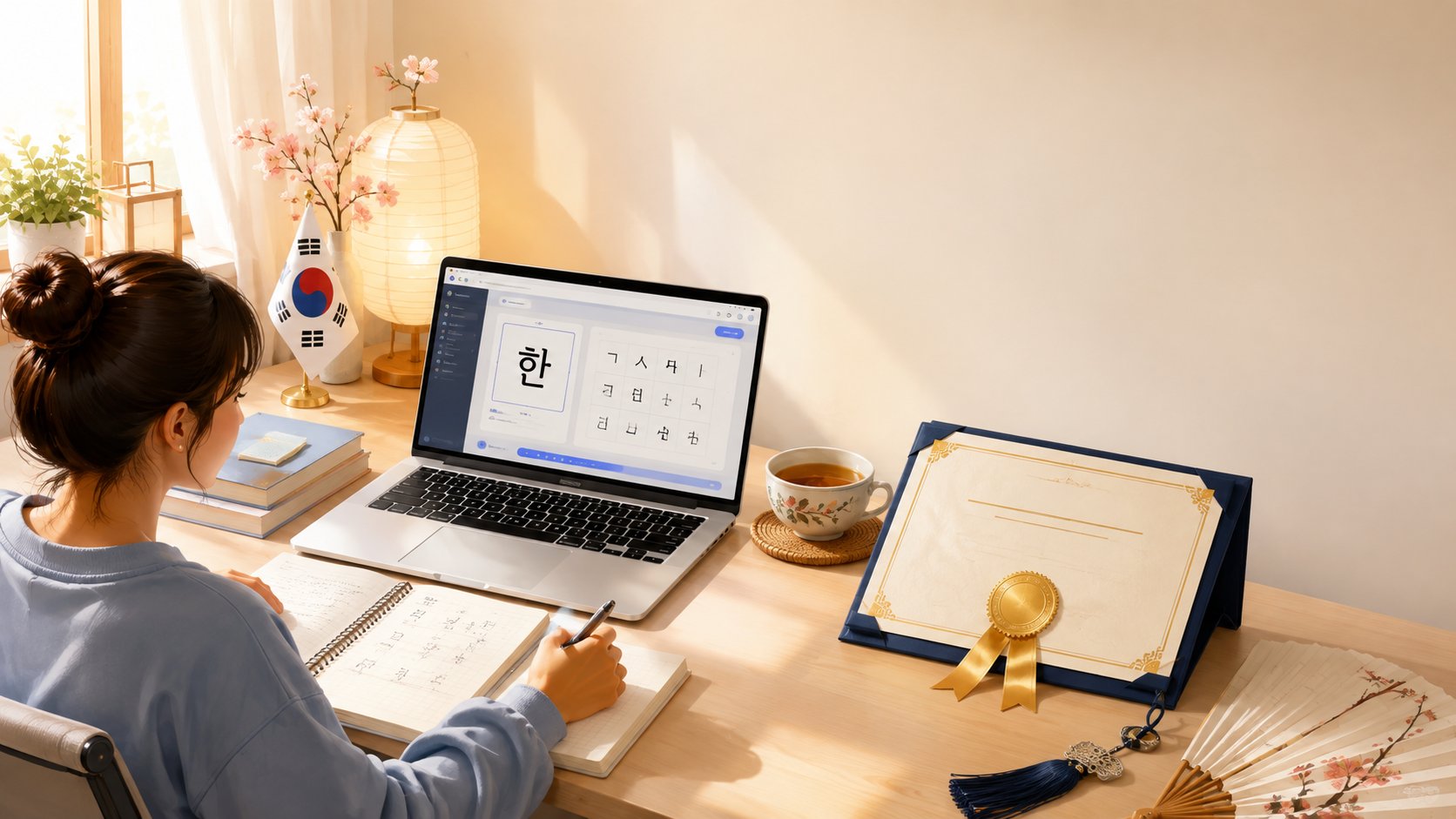
We give you a detailed certificate. Once you finish, you’ll receive a certificate showing your level, the skills covered, and total instruction hours. It’s something you can confidently add to a resume or application.
We support you after certification too. Finishing a certificate doesn’t mean the learning stops. Graduates can move into higher-level courses or join conversation practice groups.
We give ongoing feedback, not just a final grade. Instructors comment on your pronunciation, grammar, and writing throughout each unit. So certification day rarely comes as a surprise — you’ll already know where you stand.
We deliver your certificate digitally. You’ll get a downloadable file you can print or share on professional platforms. No extra steps required.
A Realistic Path: From Beginner to Certified Speaker
Curious what the journey actually looks like? Here’s a general roadmap.
Weeks 1–4: Foundations. You’ll learn to read and write Hangul. You’ll master basic pronunciation. You’ll pick up greetings and introductions. Most beginner certificates confirm these exact skills.
Months 2–4: Core grammar and vocabulary. This stage covers present and past tense, question formation, and everyday vocabulary. A beginner-to-intermediate certificate usually reflects the ability to order food, shop, or make introductions.
Months 4–8: Conversational proficiency. Lessons shift toward natural conversation. You’ll build vocabulary, sharpen listening skills, and learn formality levels. An intermediate certificate here shows you can hold a sustained conversation.
Beyond 8 months: Advanced fluency. At this stage, you’ll understand idioms. You’ll follow media without subtitles. You’ll read longer texts comfortably. Advanced certification reflects real professional or academic-level communication.
Each stage ends with an assessment. So your certificate level is always verified, never assumed.
Who Benefits Most from a Certified Online Korean Course?
Certification isn’t just for language enthusiasts. It has real, practical value.
Students applying to Korean universities. Many exchange programs ask for documented proof of language ability.
Professionals working with Korean companies. A certificate gives employers a credible, documented signal of your communication skills.
Travelers and expats. If you’re planning an extended stay or relocation, casual conversation skills aren’t always enough. Certification proves a deeper level of ability.
K-culture enthusiasts. If you’ve picked up Korean informally through dramas or music, certification turns that effort into a recognized credential.
Career changers. Roles in international business, translation, tourism, or education often value a Korean certificate on a resume.
Heritage learners. Some students grow up hearing Korean at home but never learn to read or write it formally. A certified course helps fill in those gaps. It turns partial, informal knowledge into complete, confirmed proficiency.
Content creators and hobbyists. If you create content about Korean culture, food, or entertainment, a certificate adds credibility. It shows your audience that your knowledge goes beyond surface-level interest.
What a Typical Certified Course Week Looks Like
It helps to know what day-to-day learning actually involves. Here’s a sample structure many students follow.
Live class sessions. Most weeks include one or two live sessions with an instructor. These focus on speaking practice, grammar review, and direct feedback.
Self-paced lessons. Between live classes, students work through structured video lessons and readings at their own pace. This reinforces what was covered live.
Vocabulary and listening drills. Short daily exercises help build vocabulary and train your ear for natural pronunciation and rhythm.
Writing practice. Regular writing assignments build comfort with Hangul and sentence structure. Instructors often review this work directly.
Progress check-ins. At set points, students complete short assessments. These aren’t just tests — they’re checkpoints that show whether you’re ready to move forward.
This kind of routine keeps learning consistent. It also means certification never feels sudden. By the time you reach an assessment, you already have a good sense of how you’ll do.
How to Get the Most Value from Your Certificate
Earning a certificate is a milestone. But how you use it matters just as much.
Add specifics to your resume. Don’t just write “Korean certificate.” Include the level, the skills covered, and the institution. This gives employers a clearer picture of your actual ability.
Keep practicing after you finish. A certificate documents what you’ve learned. But real-world practice — through conversation exchanges, media, or travel — keeps those skills sharp.
Treat it as a stepping stone. Many learners stop after their first certificate. But it’s really just a checkpoint. Consider what’s next: a higher level, TOPIK prep, or specialized vocabulary for work.
Be ready to explain it. If you mention your certificate in an interview, be ready to briefly describe the course. This builds credibility beyond the document itself.
Save your progress reports. If your course gave you feedback along the way, hold onto it. It can support academic applications that want a fuller picture of your growth.
Online Certificate vs. TOPIK: What’s the Difference?
This is a common point of confusion. Let’s break it down.
TOPIK stands for Test of Proficiency in Korean. It’s a standardized exam run by the Korean government. It’s widely used for university admissions, scholarships, visas, and immigration. It carries formal, government-level recognition.
Course certificates are different. They reflect completion and skill within a specific program’s curriculum. They’re not a replacement for TOPIK when it’s specifically required. But they still serve a real purpose. They document structured learning. They track progress over time. And they provide evidence of consistent study when TOPIK isn’t required.
For many learners, the best path combines both. Use a certified course to build a strong foundation. Then use that foundation to prepare for TOPIK, if and when you need it. These two things aren’t competitors. They work well together.
The Value of Structure, Even Without External Requirements
Not everyone needs a certificate for a job or a university application. And that’s completely fine.
Many learners choose certified courses simply because the structure works better. Courses with certification tend to have clearer curricula. They offer more consistent assessment. They build stronger accountability than open-ended, self-paced learning.
Even if you never show your certificate to anyone, working toward one still helps. It pushes you to study consistently. It pushes you to take assessments seriously. And it helps you actually consolidate what you’ve learned, instead of passively watching lessons.
In a way, the certificate is a byproduct. The real value is the discipline that comes from pursuing one.
Common Questions About Certified Online Korean Courses
Is an online Korean certificate recognized by employers? Course certificates aren’t the same as government exams like TOPIK. But a detailed, instructor-verified certificate is widely accepted as credible evidence, especially alongside real conversational skill.
How is a course certificate different from TOPIK? TOPIK is South Korea’s official proficiency test. It’s often required for university admission or certain visas. A course certificate reflects skills from a specific program. It’s a great complement to TOPIK prep, but not always a substitute.
How long does it take to earn a certificate? It depends on the level. Beginner certificates can often be earned within a few months. Advanced certification typically takes eight months to a year or more.
Do I need to pass a test to get certified? Yes. Meaningful certification always involves assessment — written, spoken, or both. This confirms the skills on your certificate are genuine.
Can beginners with no Korean background start a certified course? Absolutely. Programs are designed to start from zero. You’ll learn Hangul and foundational grammar first, then work toward higher certification levels.
Will the certificate expire? Course certificates generally don’t expire. They document a point-in-time achievement, not an ongoing credential. That said, skills can fade without practice. Keep using your Korean after certification.
Can I use an online certificate for a study-abroad application? It depends on the program. Some accept course certificates as supporting evidence. Others require standardized scores like TOPIK. Always check the specific requirements, and use your certificate alongside any officially required documents.
Mistakes to Avoid When Choosing a Certified Course
Not every “certified” course delivers real value. Watch out for these common pitfalls.
Automatic certificates. If a course hands out a certificate just for finishing videos, be cautious. Real certification involves testing, not just attendance.
No live interaction. Speaking is the hardest skill to self-assess. Courses without live instructor feedback often overestimate your actual conversational ability.
Vague level labels. If a course can’t clearly explain what “beginner” or “advanced” means in practical terms, it’s hard to know what the certificate actually represents.
No sample certificate shown. Reputable programs are usually happy to show you what the certificate looks like, and what specific information it includes, before you enroll.
Overpromising credentials. Be wary of any course that claims its certificate is equivalent to TOPIK or a government-issued credential. As covered earlier, these serve different purposes.
Taking a few minutes to check these details before enrolling can save you from ending up with a certificate that doesn’t hold up when it actually matters.
Getting Started with Online Korean Language Courses with Certificate
Choosing to learn Korean is already a meaningful decision. Choosing a course that certifies your progress makes that effort count for even more. Whether your goal is academic, professional, or simply personal pride, online Korean language courses with certificate options give you a clear path forward.
At Global Diction Studio, our certified Korean programs take you from your very first “안녕하세요” to a recognized, documented level of fluency. You’ll get live instructors, structured milestones, and a certificate that reflects real, tested skill every step of the way.