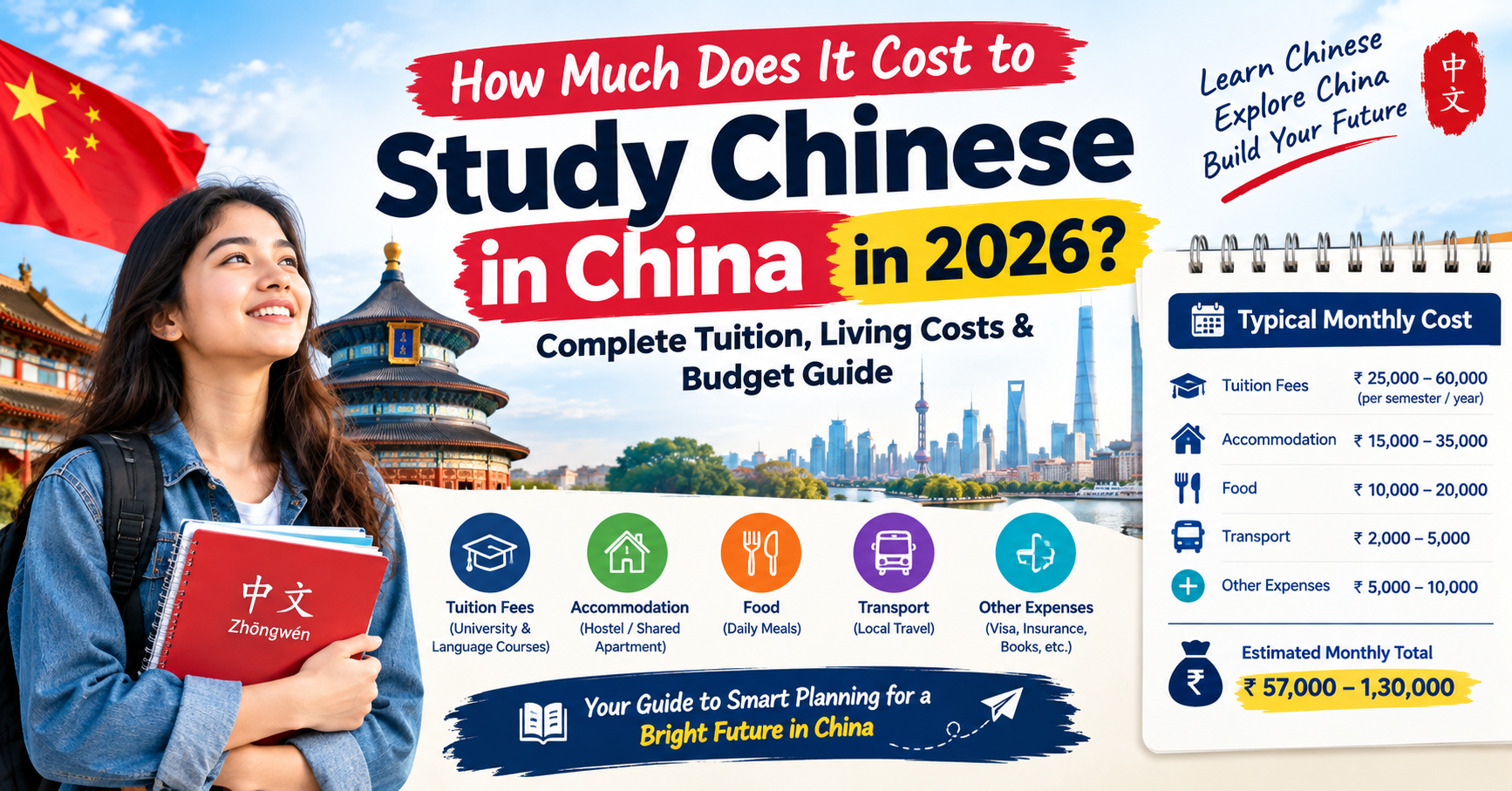
How Much Does It Cost to Study Chinese in China
Studying Chinese in China is widely regarded as one of the most effective ways to achieve real fluency in Mandarin. Immersion allows learners to practice the language daily in authentic situations, hear native speakers constantly, and progress much faster than through online classes or courses taken outside China. Many students aim to reach HSK 4 or HSK 5 within one academic year of full-time study.
However, the total cost depends on several factors: the type of program you choose, the city you study in, whether you live in a university dormitory or a private apartment, your lifestyle, and whether you receive any scholarships. This comprehensive guide provides a detailed, research-based breakdown of all major expenses for international students in 2026. It includes multiple comparison tables, realistic budget scenarios, scholarship information, and practical advice so you can plan accurately.
Types of Chinese Language Programs and Their Cost Implications
Chinese language programs in China fall into several main categories, each with different pricing structures and learning outcomes.
University Non-Degree Language Programs
These are the most popular choice for serious learners. Students enroll as non-degree language students at Chinese universities. Classes usually run 18–25 hours per week and follow a structured curriculum aligned with HSK levels. Most universities offer multiple proficiency levels from absolute beginner to advanced.
Short-Term and Summer Intensive Programs
These last from 4 to 12 weeks and are ideal for students who want a trial experience or can only study during holidays. They are more expensive on a per-week basis but lower in total cost.
Private Language Schools
Schools such as LTL Mandarin, That’s Mandarin, Mandarin House, and others offer flexible start dates, smaller class sizes (often maximum 6–8 students), and one-on-one options. These provide more personalized attention but cost significantly more than university programs.
Degree Programs with Chinese Language Components
Some students enroll in bachelor’s or master’s degrees taught in Chinese and spend the first year focusing heavily on language. Tuition for full degree programs is usually higher than pure language programs.
Detailed Tuition Fee Ranges in 2026
Tuition is the first major cost students need to budget for. University programs remain the most cost-effective option for most learners.
Table 1: Tuition Fees by Program Type (2026 Estimates)
| Program Type | Duration | Tuition Range (RMB) | Approximate USD | Typical Weekly Hours |
|---|---|---|---|---|
| Summer / Short Intensive | 4–8 weeks | 5,000 – 12,000 | 700 – 1,700 | 20–30 |
| One Semester | 4–5 months | 8,000 – 18,000 | 1,100 – 2,500 | 18–25 |
| Full Academic Year | 10–12 months | 15,000 – 35,000 | 2,100 – 4,900 | 18–25 |
| Private School Group Classes | Full year | 40,000 – 60,000+ | 5,500 – 8,300+ | 15–25 |
| One-on-One Private Lessons | Flexible | 150 – 400+ per hour | 20 – 55+ | Custom |
University-Specific Examples (Approximate 2026 Figures)
- Beijing Language and Culture University (BLCU): 22,000–28,000 RMB per year
- Fudan University (Shanghai): Around 25,000–26,000 RMB per year
- Peking University and Tsinghua University: 30,000–35,000 RMB per year
- East China Normal University and similar mid-tier options: Approximately 20,000 RMB per year
- More affordable universities in cities such as Nanjing, Hangzhou, Qingdao, Chengdu, Wuhan, and Kunming: Often 13,000–18,000 RMB per year, with some programs as low as 6,500–14,000 RMB
Application and registration fees usually range from 400 to 800 RMB and are typically non-refundable. Always confirm the latest figures on the official university websites, as slight adjustments can occur each academic year.
Living Costs: The Biggest Variable Expense
Living costs vary dramatically depending on the city. Tier-1 cities such as Beijing and Shanghai are the most expensive, while many excellent language programs exist in more affordable Tier-2 and Tier-3 cities.
Table 2: Monthly Living Cost Breakdown by City Category (2026)
| Expense Category | Beijing / Shanghai (RMB) | Mid-Tier Cities (Guangzhou, Hangzhou, Nanjing) (RMB) | Cheaper Cities (Chengdu, Wuhan, Kunming, Xi’an) (RMB) |
|---|---|---|---|
| University Dormitory (shared) | 800 – 2,000 | 600 – 1,500 | 500 – 1,200 |
| Shared Off-Campus Apartment | 2,000 – 5,000 | 1,500 – 3,000 | 1,000 – 2,500 |
| Food (canteen + local eating) | 1,200 – 2,500 | 1,000 – 1,800 | 800 – 1,500 |
| Local Transportation | 200 – 400 | 150 – 300 | 100 – 250 |
| Mobile Phone + Internet | 100 – 200 | 80 – 150 | 50 – 120 |
| Utilities and Miscellaneous | 200 – 500 | 150 – 400 | 100 – 300 |
| Estimated Monthly Total | 3,500 – 6,000 | 2,500 – 4,500 | 2,000 – 3,500 |
Food is one of the most affordable aspects of life in China if you primarily eat at university canteens (typically 8–25 RMB per meal) or local restaurants. Cooking at home further reduces costs. Frequent Western meals or imported products will increase your food budget substantially.
Other Essential Costs
Students must also budget for several mandatory and semi-mandatory expenses:
- Student Visa (X1 or X2) and Residence Permit: Application fees vary by nationality (often equivalent to 100–200 USD). After arrival, long-term students convert the visa into a residence permit, which involves additional fees of several hundred RMB.
- Medical Insurance: Required by most universities. University plans usually cost 600–1,000 RMB per year.
- Textbooks and Learning Materials: 300–500 RMB per semester.
- HSK Examination Fees: Between 150 and 650 RMB depending on the level.
- Initial Setup Costs: Airport transfer, Chinese SIM card, bedding, and basic household items can total 500–1,500 RMB.
- Personal and Leisure Expenses: Highly variable. Weekend travel by high-speed rail is relatively affordable (Beijing to Shanghai tickets often cost 500–600 RMB).
Complete Annual Budget Scenarios
Combining all the above elements produces the following realistic annual budgets for a full academic year of Chinese language study.
Table 3: Full-Year Cost Estimates for Self-Funded Students (2026)
| Budget Level | City Type | Tuition (RMB) | Living Costs (RMB) | Other Costs (RMB) | Total (RMB) | Approximate USD |
|---|---|---|---|---|---|---|
| Budget-Conscious | Cheaper inland city | 14,000 – 18,000 | 24,000 – 36,000 | 3,000 – 5,000 | 41,000 – 59,000 | 5,700 – 8,200 |
| Mid-Range | Mid-tier city | 18,000 – 25,000 | 30,000 – 48,000 | 4,000 – 6,000 | 52,000 – 79,000 | 7,200 – 11,000 |
| Comfortable / Premium | Beijing or Shanghai | 25,000 – 35,000 | 42,000 – 72,000 | 5,000 – 8,000 | 72,000 – 115,000 | 10,000 – 16,000 |
Scholarships That Can Greatly Reduce or Eliminate Costs
China offers several major scholarship programs specifically useful for language learners:
Chinese Government Scholarship (CSC)
This is the most comprehensive option. It typically covers full tuition, on-campus accommodation, comprehensive medical insurance, and a monthly living stipend (around 2,500 RMB for undergraduate-level language study, higher for postgraduate). Competition is strong, and applications usually open early in the year.
International Chinese Language Teachers Scholarship (formerly known as the Confucius Institute Scholarship)
This scholarship is particularly suitable for pure Chinese language study. It covers tuition, dormitory accommodation, a monthly stipend (approximately 2,500–3,000 RMB), insurance, and often a one-time settlement allowance. It supports one-semester and one-year language programs as well as certain degree programs related to Chinese language teaching.
University and Provincial Scholarships
Many individual universities and local governments offer partial or full scholarships based on academic merit, nationality, or specific bilateral agreements. These can significantly reduce tuition or provide additional living support.
Students are strongly advised to begin researching and preparing scholarship applications several months in advance. Deadlines commonly fall between January and May for programs starting in September.
Choosing the Right City for Your Budget and Goals
Beijing offers the largest number of high-quality Chinese language programs and the purest Mandarin environment. It is ideal for serious academic progress but comes with the highest living costs.
Shanghai provides a highly international atmosphere and excellent universities. It is slightly more expensive in some categories than Beijing and offers strong networking opportunities.
Hangzhou, Nanjing, Chengdu, Wuhan, Kunming, Qingdao, and Xi’an deliver excellent value. Living costs are substantially lower while teaching quality at many universities remains high. These cities are particularly recommended for students who want to maximize their budget without sacrificing program quality.
Practical Strategies to Control Costs
Several practical steps can help keep expenses under control:
- Prioritize university dormitories in the first year.
- Eat regularly at campus canteens and local restaurants.
- Choose a Tier-2 or Tier-3 city if budget is a primary concern.
- Apply for multiple scholarships simultaneously.
- Share textbooks or buy second-hand materials.
- Use public transport and shared bicycles extensively.
- Limit expensive Western food and imported products.
- Opt for a full academic year rather than several short programs when possible, as the per-month cost is usually lower.
Final Summary and Planning Advice
In 2026, the total cost of studying Chinese in China for one full academic year typically ranges from about 41,000 RMB in a budget scenario in a cheaper city to over 100,000 RMB for a more comfortable lifestyle in Beijing or Shanghai. University language programs continue to offer the best balance of quality, structure, and affordability for most international students.
The combination of relatively moderate tuition fees, the possibility of substantial scholarships, and the unmatched benefit of full immersion makes studying Chinese in China an attractive option compared with many Western study-abroad destinations. Careful selection of city and program, early scholarship applications, and disciplined daily spending habits can keep total costs manageable while delivering strong language results.
Prospective students should visit the official websites of target universities, check the latest 2026–2027 fee schedules, prepare application documents well in advance, and build a realistic personal budget that includes both fixed and variable expenses. With proper planning, the investment in time and money can yield significant academic, professional, and personal returns through improved Chinese proficiency.








Please share your valuable inputs